Charlie Perez-Tlatenchi & Jane Ursula Harris
Collapsing the World Into Diasporic Images
The son of Mexican immigrants, Charlie Perez-Tlatenchi’s story is that of a quintessential first generation native New Yorker. Raised in Sunset Park, Brooklyn during the 1990s and aughts when there was a massive influx of immigrants from Latin America and China, he grew up speaking Spanish until he attended school. The multimedia artist’s early photo-based collages and interest in the visual vernacular of street life bear the imprint of this vibrant mix of cultures. So too can one find the palimpsests of his experiences in the city’s DIY noise and metal scene he came of age in (marked by densely layered sounds) and his involvement in the Occupy Wall Street movement, which helped politicize his understanding of art’s potential.
By the time Perez-Tlatenchi got his MFA in Photography at Bard, his practice had begun to visualize a broader sense of the world through dedicated research to the histories of globalization. Traveling to places as far flung as Mexico, Asia, and Palestine, he traced trade routes connecting China to the Americas through the demand for silver, and limned the ways Catholicism paradoxically functioned to justify colonialism and survive it. Through a formal relationship to photography that increasingly incorporates sculptural elements and commercial methods, his work continues to limn the diasporic condition through compositions that resist legibility and are never fixed.
Today the artist lives and works in Dyker Heights, a Brooklyn neighborhood that has yet to be swept up by the gentrifying forces that have already transformed Sunset Park. He shares his life there with his Taiwanese-Brazilian wife and baby girl. As we sat down in his studio to talk, we discussed his trajectory as an artist and what he’s working on now.
JUH Tell me about growing up in Sunset Park.
CPT Well, when I started school I didn’t know what anyone was saying and I had to take ESL classes alongside other Latin American and Chinese classmates. I had a bunch of friends in my apartment building who each spoke a different language in their homes, and we would all go out and play on our corner during the summer. Not to say it was some ideal vision where all colors and creeds came together in harmony but there was a lot of laughter and despite the usual teasing, including racist jokes, we shared in each other's cultures. My middle school marching band for example performed for the Chinese New Year celebration on 8th Avenue every year, a place where my mom would take me to buy produce communicating in broken English and hand gestures. It gave me a sense of how different cultures can be bridged beyond language.
JUH Right, figuring out how to connect despite language barriers, which is often an essential part of being a visual artist.
CPT Exactly, creating a visual way to communicate one’s understanding of the world to a broader audience. For me its a collapsing of images into compositions that engage collage and layering.
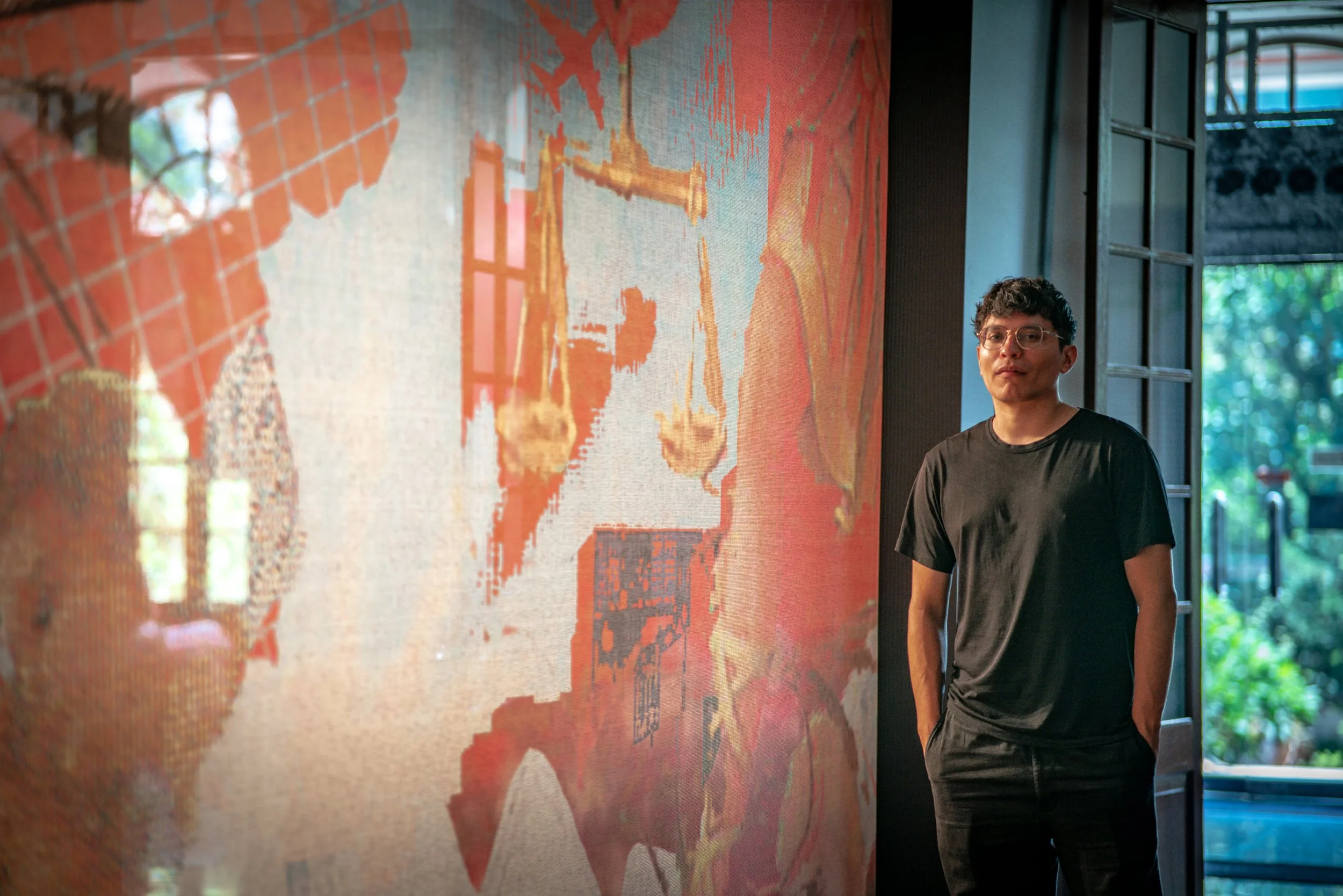
JUH What you've described as “the way images live and deteriorate on the street”, something endemic to urban life. Would you say the digital collage that comprised your recent Canal Projects mural, Triumphant Currents, Auspicious Winds (2025) reflects this?
CPT Definitely. That installation was 10 years in the making. By the time I was putting it together, I’d already been layering scenes captured on the streets of New York and elsewhere into single images. They were abstract in ways that reflected this sense of how visual culture amalgamates, overlaps and disintegrates in public. So that installation came out of the same impulse.
JUH Just scaled up and re-presented through commercial printing techniques. Why that format?
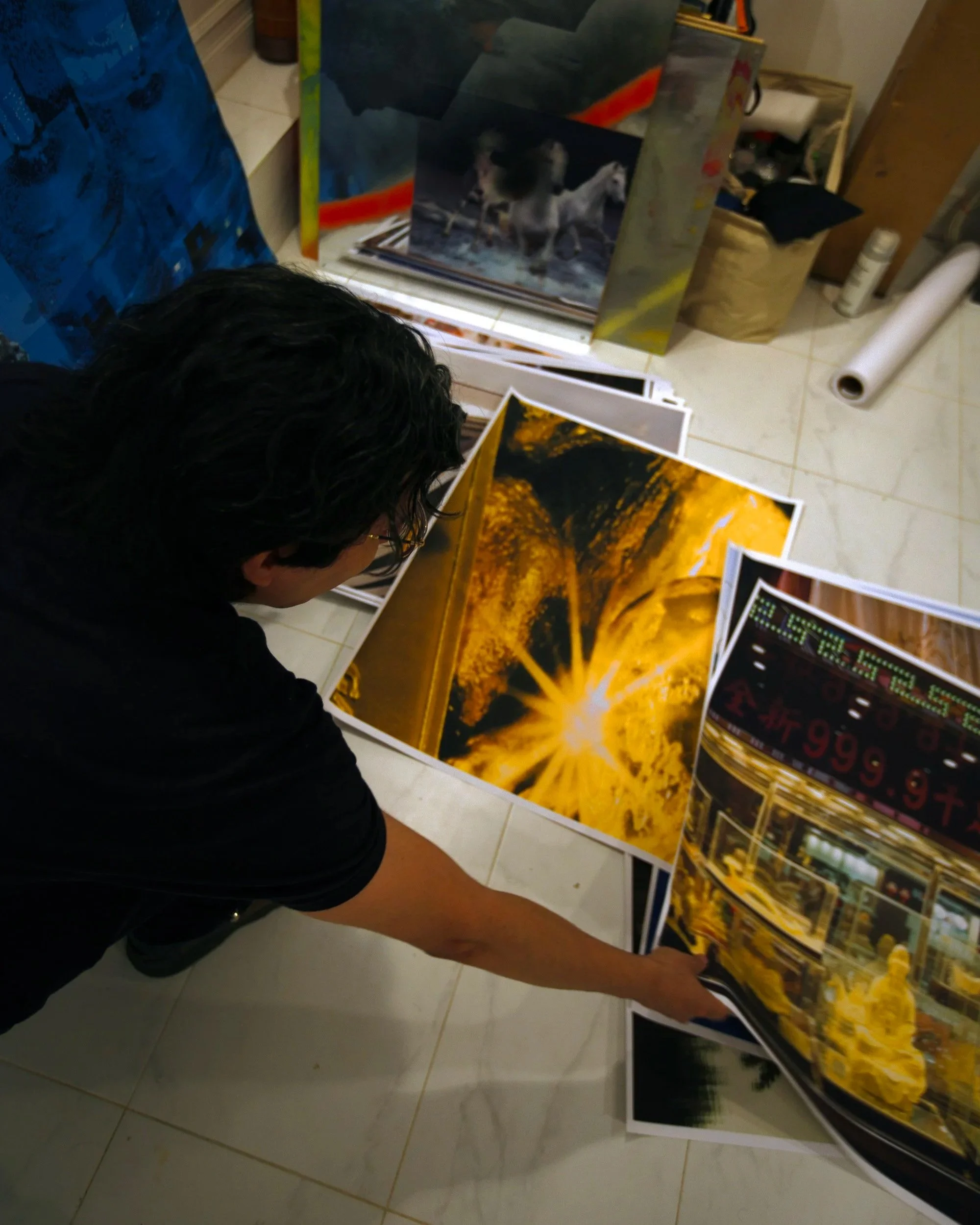
CPT I wanted to specifically use perforated vinyl like the kind you find in convenience store windows and also lenticular prints borrowed from everyday visual culture. The addition of the video monitors (that are only seen after sunset) let me play with visibility as the perforated vinyl only became transparent at night. The looping video appears like an apparition in the form of a moving collage that weaves together the post-colonial visual cultures of Latin America and Asia that were first connected through maritime trade centuries ago. The interspersed footage, like the images in the window mural, was shot throughout the course of my field research at former colonial ports between Latin American, Asia, and Europe.
JUH Right, I found that really effective because the work feels like it's moving and shapeshifting. Talk more about the imagery, which merges scenes from your trips with spiritual references - prayer cards, the Archangel Michael holding the scales of justice, the sea goddess Mazu - and the story of colonialism through global trade.
CPT Yes, the mural explores the trade routes and imperial legacies that made a place like Sunset Park possible. It's the same act of collapsing the world into a single image.
JUH A world that’s entangled with your own history as well as this larger story. Can you talk a little about the use of spiritual imagery, why it's there, and how it's showing up in your current practice?
CPT I’ve been engaging with religious imagery as long as I’ve had my visual practice. I was raised Roman Catholic and while my family was devout, I became an atheist soon after my confirmation due to personal doubts, and a growing awareness of the Church’s direct involvement in colonialism throughout the centuries.
Catholic imagery in my early collage work was a way to work through that and also explore the layered meanings the faith has in a Latin American immigrant context: how it simultaneously provides strength to navigate an unfamiliar place and reinforces narratives of subjugation inherited from the era of Spanish rule.
JUH Can you give an example of how this manifests in specific work?
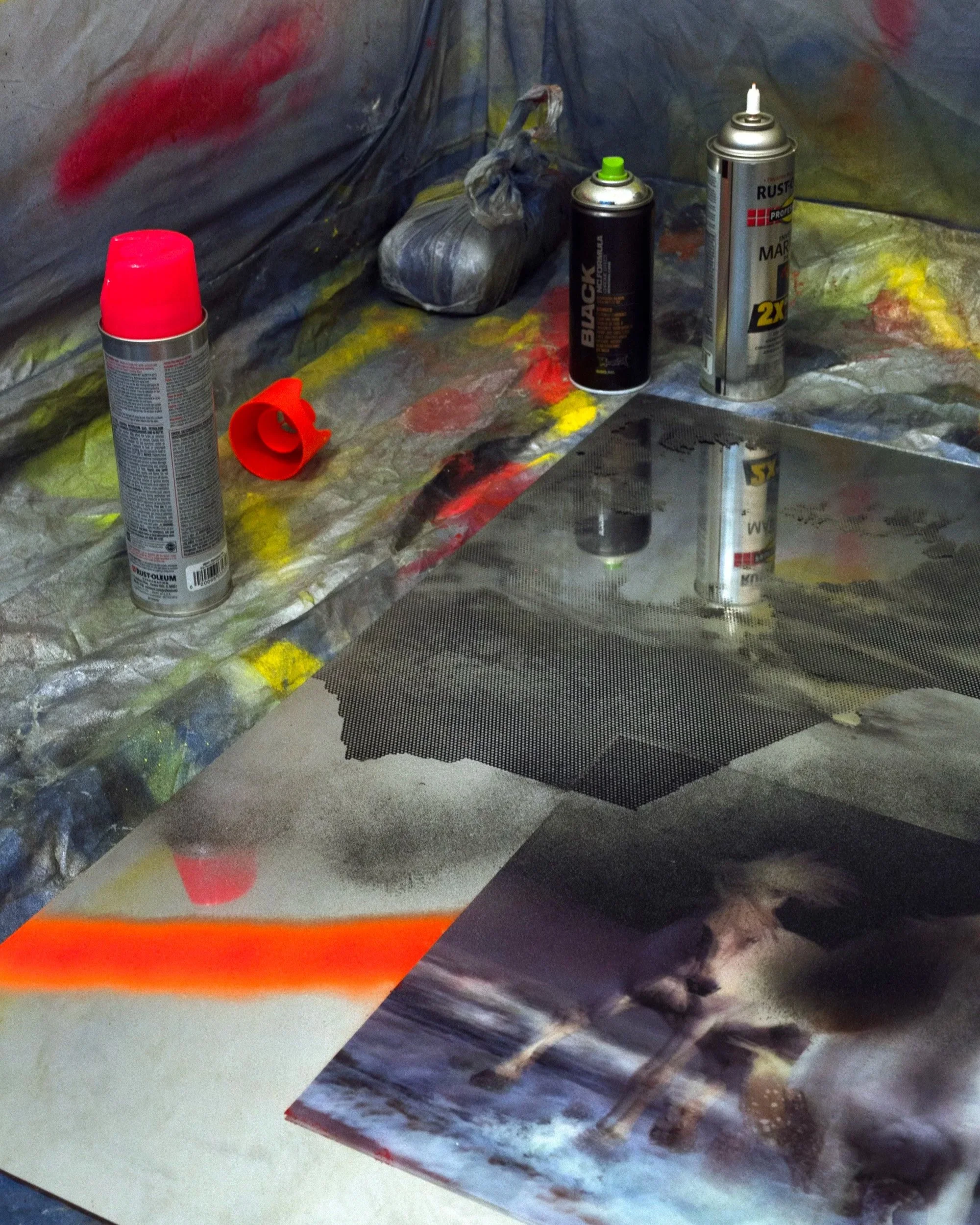
CPT Sure, in 2022 I had the privilege of spending a month in Palestine around Christmas. I was staying in Bethlehem and lived right next to the Nativity Church. A photo I took of the Judean desert where the temptations of Christ occurred is part of the mural. I spent my time there experiencing these ancient Christian sites, and how they have become active sites of contention as they now go through active colonization by the ongoing occupation. In my show last Fall at haul gallery, Heaven and Ground, I honed in on this growing instability and the impact of faith in the current global order through a mix again of commercial printing techniques, photography and some painterly abstraction via spraypaint.
JUH Your work also includes many non-western references.
CPT Yes, the mural on Canal Street also introduced my blossoming appreciation and awareness of the Fujianese sea goddess Mazu, who I encountered several times during my six month journey through East Asia in 2024. She serves as the patron deity for sailors and, as a result, the Chinese diaspora around the world. I also utilized 祥云, or “auspicious clouds” in English, as an iconographic counterpoint to the Mesoamerican speech scroll that has already been a part of my practice for years now.
JUH Some of the works shown at haul gallery incorporate images of horses - symbols of strength and virility as well as colonial conquest. Horses appear again in your current body of work. I know the latter conjures the story of the archangel Michael, the commander of God’s army, who you invoke as an avatar of justice, right?
CPT Correct! We know him as San Miguel in the Spanish speaking world, and his image alongside his name is ever present. There was a certain point where I asked why such a cathartic display of power is so trivialized in everyday life. His strong presence as an image to this day is a visual reminder of the colonial legacy deeply embedded in the consciousness of our community. It goes back to my skepticism of faith and questioning how Christianity and Catholicism came to become a manifestation of the same evil it speaks out against. The archangel is meant to be the just judge but also serves as a reminder of the thirst for wealth and violent conquest exhibited by god’s children in Europe immediately following the so-called “Age of Discovery.”
JUH Walk me through this symbol as it moves across these bodies of work, and how it functions narratively in the newest Archangel series.
CPT One of the ways the horse functions in my work connects back to the way it was used as a tool to enforce Christian judgement upon the Aztecs. But they also serve as tools of resistance, symbols for perseverance, or for espousing masculine energy in other contexts. Depending on the composition, I will render these recurring symbols in varying levels of saturation that are comparable to the commercial visual language that I take direct influence from. Lately, I have been experimenting with desaturating these images in the same way that years of sun exposure would cause photo degradation. It’s one of the ways I destabilize images that can be considered solid and infallible such as the archangel.
JUH To what end?
COT Well I’m obsessed with symbols that feel like they’re as ubiquitous as the air we breathe, that have circulated and recirculated through many technological epochs, and feel as if they've always been there. They’re full of meaning yet are taken for granted and have become cheapened in some ways. Of course, the horse is a lot more universal than the Archangel and his scales of justice, but I also see that the scales in this heavenly context connect to how western notions of law and order persist throughout the current world order.
JUH This is very interesting because it conveys a political perspective that your work refuses to articulate in didactic terms. Assembling references that span centuries and cultures, history and myth, you blur and obscure instead through a formal language that plays with ideas like background versus foreground, narrative versus abstraction. It reminds me of your comment that you find it “counterproductive to make things legible to everyone”. Can you expand on this perspective – perhaps in relation to the exaggerated speech scrolls (adapted from Mesoamerican codices) that make appearances throughout your bodies of work and which paradoxically are images of sound?
CPT I love that you focus on the speech scroll because it encapsulates what you bring up here so well. It is a Mesoamerican glyph that denotes speech typically uttered by a notable figure from the nobility as the written and spoken word was inextricably tied to power. It’s also a clear example of abstraction that precedes European influence. I have removed them from their original context so they become representations of disconnected speech relegated to the wind that moves through my compositions. The scrolls are often scanned from printed reproductions and I make this apparent by leaving the print matrix on it. This is an acknowledgement that while I am reflecting back on my undeniable indigenous history, my own understanding of this history is one I reconnect with through research rather than lived experience.
In the end, I don’t expect or want anyone to catch all of these connections instantaneously. I’ve always considered the experience of art as a fundamentally visceral one. What matters first is whether the work hits the viewer on a register that can’t be immediately explained but is nonetheless felt. Multiple images exist in the same pictorial plane the way different languages did in my neighborhood growing up.
JUH Like diasporic compositions that communicate without a universal language?
CPT Exactly!