

Zain Alam & Travis Diehl
Approaching Perfection
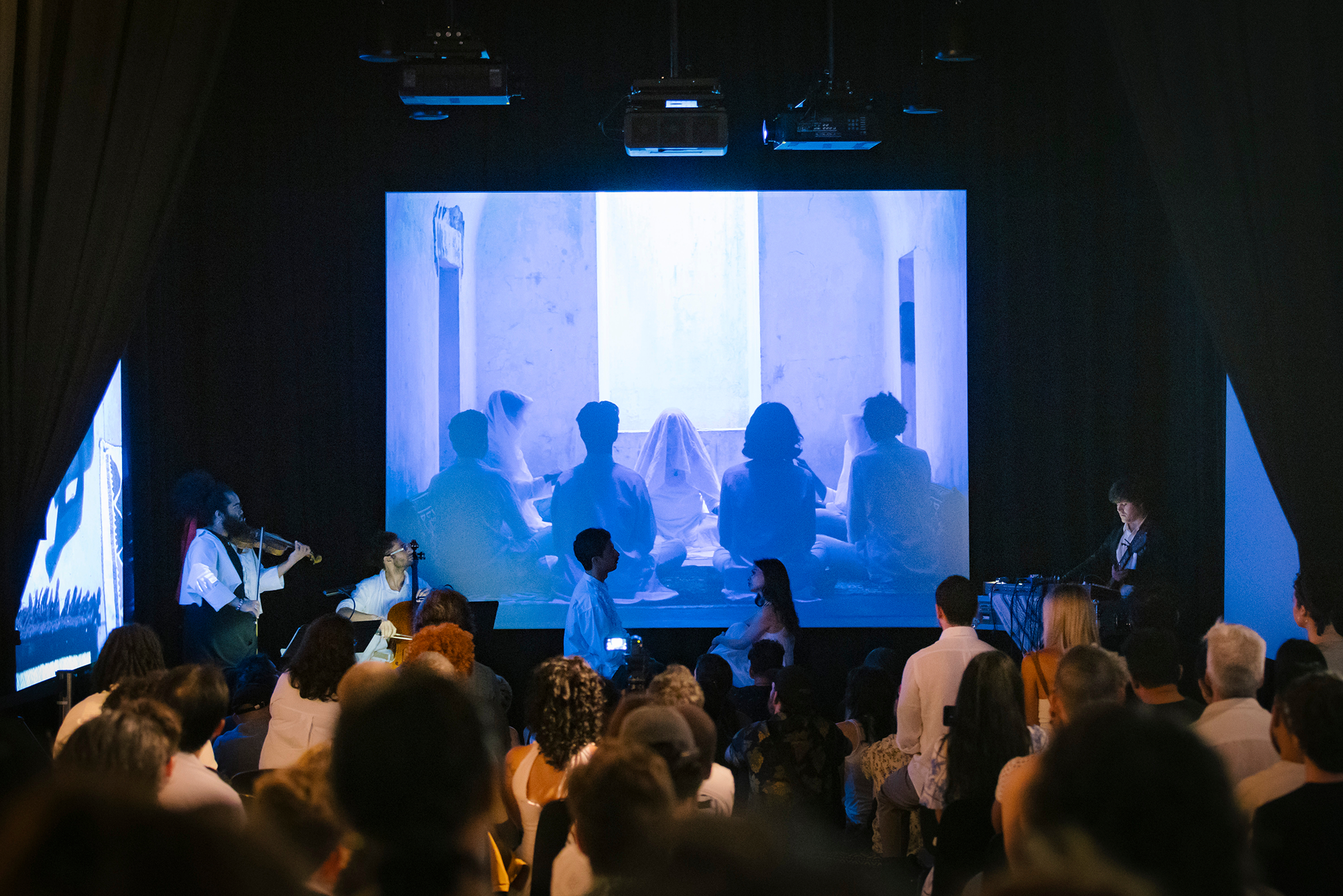
When Zain Alam (b. 1990) says art is a spiritual practice, he means it in a specific way: according to Islamic tradition, artists channel the divine energy of creativity.
Born in Queens to a Hindustani family, Alam has made a long study of Islam’s rituals and philosophy as both an artist and an academic. A turning point came while he was traveling South Asia collecting oral histories for the 1947 Partition Archive, listening to the experiences of people who had lived through the creation of Pakistan as a “Muslim” nation separate from a “Hindu” India. He was impressed by the hand gestures of prayer and melodies his subjects shared, and how these textures seemed to convey a sense of place regardless of where the speakers were on the planet. For him, those gestures were everything.
Alam’s recent work with sound and video cites the way abstractions like beauty and proportion can be names for God. Just as Islamic art derives from geometry and algorithms, Alam’s work has structuralist underpinnings. Meter & Light, a multichannel video project, takes cues from the rhythms of Islamic devotion. There are dramatically lit closeups of prayer beads and of hands moving across invisible Arabic text. For Night, the newest section, Alam constrained the piece according to Islamic tradition by avoiding showing faces and only using sounds made by the human body, such as snaps, slaps, and vocals. He processed the audio to create looping ticks and tones reminiscent of experimental electronic compositions of the 1970s. In all, his work infuses distinctly contemporary, digital forms with elements that haven’t changed for centuries, emphasizing their common structure. The following conversation took place over afternoon tea at Alam’s apartment in Brooklyn. It has been edited for length and clarity.
TRAVIS DIEHL Maybe we could start with how you became an artist.
ZAIN ALAM It was during the time I worked for the Partition Archive. I was paying close attention to these sounds that people remember from their childhood from 50, 60 years ago, these songs, these melodies that connect them to a certain village that they can no longer access anymore because they can’t cross the border. Watching
them reconstruct that to me on camera, watching them reconstruct that with their fingers, I thought, oh, I’m interested in sitting with this thing for a really long time. At the end of the Night section of Meter & Light, the melody that I’m reciting is one that I heard at 5 a.m. every morning in Morocco. There’s one person in the city who
will sing this very soft song that grows in volume to gradually wake people up for the first prayer, rather than being woken up by the call to prayer, which in Morocco can be very loud and direct and not very melodic.
TD You studied music at Wesleyan?
ZA I went to Wesleyan, I did not study music.
I did one of those hippie dippie interdisciplinary majors. You get to do an independent project.
I went to India and Pakistan to do initial research on my family and why half of them decided to stay in India when the country split and why half of them decided to go. And to use that decision making as some kind of a lens for where those countries have gone in general, and the state of Muslims in India, especially.
TD What did you learn from that research?
ZA It’s such a long story. But I would say the most salient parts are the Muslims who stayed in India, the family who stayed in India, they’d say, we have six to 700 years of documented history of our family living in this village, on this plot of land.
Governments have changed, rulers have changed. The British have gone and left like others have gone and left. We don’t really see a reason to go somewhere where we are going to be foreigners. Whereas the ones who left left out of some idea that Muslims will always be treated as second class citizens in India.
There’s an animated question there of what ties you to soil and to land or gives you a sense of belonging. That comes back to this project. There are rituals and practices and songs that can always connect to you, even if you’re far away from the place. These are mobile and can move with you. And that was an intention with Meter & Light. You see my fingers and me swaying in Morocco and in the Rockaways. Some of these places like the Rockaways or Snug Harbor are absolutely not places of the Muslim world.
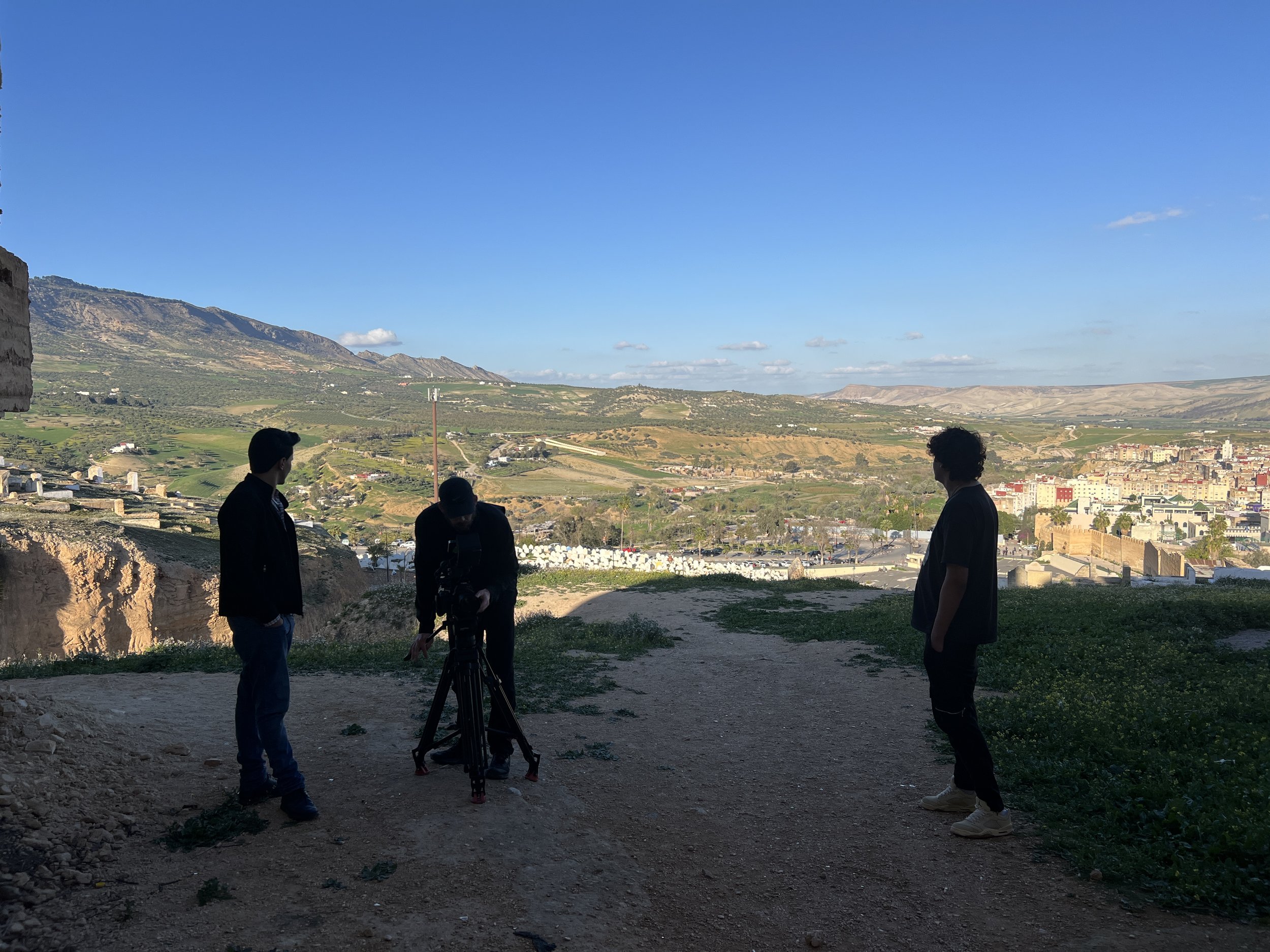
Zain Alam with collaborator Sam B. Jones and producton crew in Fes, Morocco, 2025
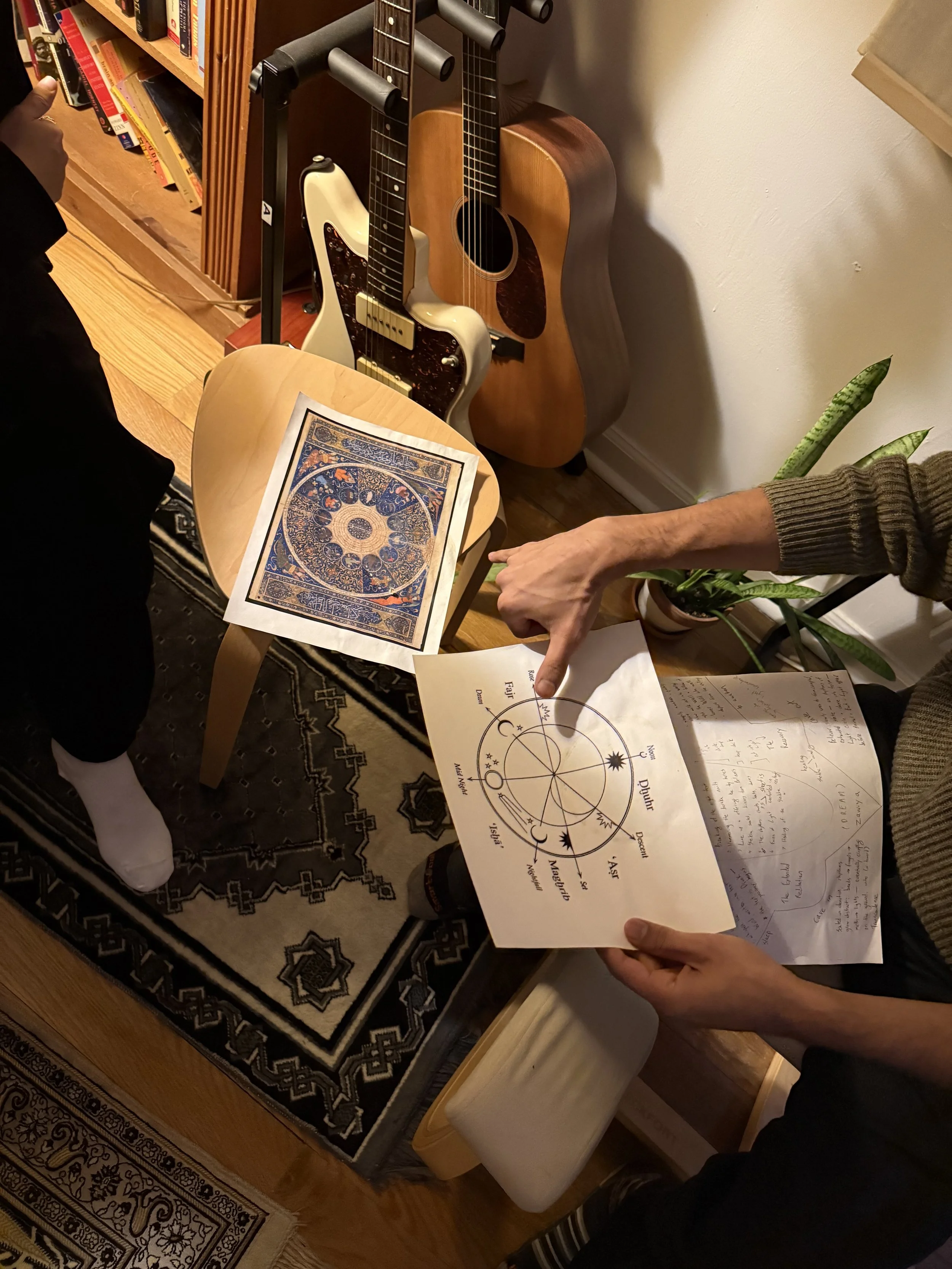
Zain Alam holding baraka nails from Nizamuddin, Old Delhi used for Sufi ceremony in Meter & Light: Night

Reference materials for astrological calculation and daily prayer cycles in Islamic tradition
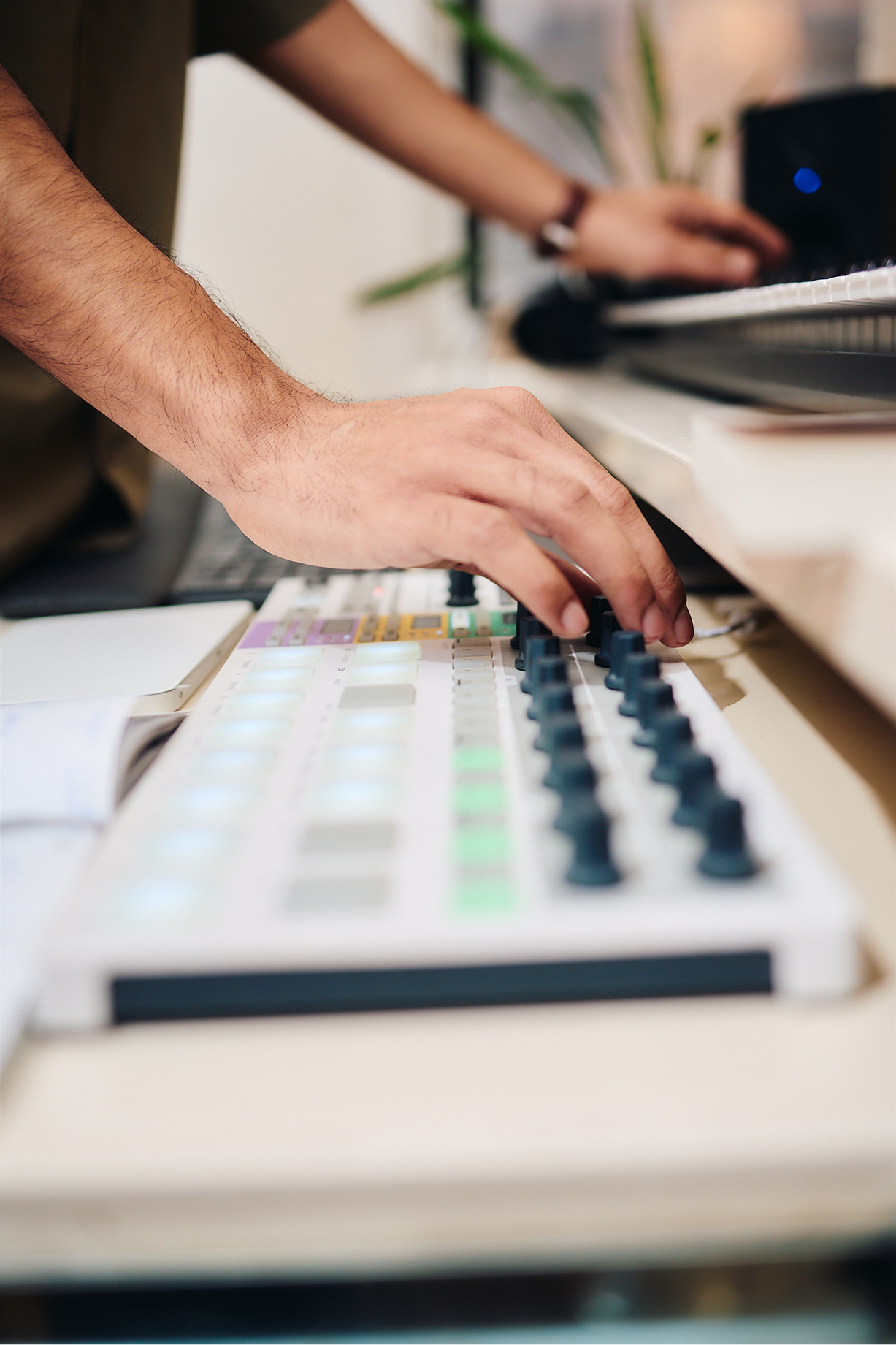
Zain Alam in studio using Arturia Beatstep Pro and Kontakt piano
TD I’m curious about your relationship to those traditions, to Islam.
ZA This is first and foremost an aesthetic exercise and project, it’s not a religious one. But the religion is one that I’m fluent in. I also think, especially for Muslims who grew up in the West but in the world in general, people associate Islam as a tradition with juridical rulings, and as things that are halal and things that are haram. Which, yes, all religions have that. But undue attention has been paid to that in the Islamic tradition. And actually there are so many genealogies of thinking about beauty, form, balance, proportion, light that exist in Islamic tradition that I’m interested in reanimating and excavating using contemporary forms.
TD There’s obviously a Western bias to Western art history. But, for example in Renaissance art, Christian imagery is thrown around in this way that’s maybe devotional, maybe not. It becomes a shorthand for art history. It doesn’t necessarily connect to the beliefs of the artist. But you don’t see Islam portrayed that way as often.
ZA After the Partition Archive project, I thought, I could really do an artistic, intellectual history of Muslim South Asia. So I started a PhD program at Harvard. I realized that place is actually so socially conservative. At that point, I’d also put out a record and was starting to do these projects and collaborating with artists. So I was torn on
whether I wanted to become an academic or go for an artistic practice. I left with a Masters after two years. But I did get to spend that time really falling in love with thestate of contemporary research in the Islamic world. And I was able to make my Indian Pakistani parents very proud by getting to come to my Masters ceremony. I also was able to get at least a base level of literary Persian and literary Arabic. And I grew up speaking Urdu-Hindi.
TD There’s a depth of knowledge and research to your videos. But they’re also very abstract, which I want to ask about, too. The zoomed-in hand gestures, or how the first shot of Night is, you know—a book. These very heavy single images. The beads. Those kinds of things.
ZA If I’m still getting to explore some of these questions in my 60s, 70s, at that point it will just be lights, color, and shape. Because I think at its purest, that’s what Islamic art is doing—through geometry, tile work, calligraphy, this sense of the divine or this sense of something bigger than yourself. Not through depictions of Jesus, or beings. Because the cosmology of the divine is not a being. It’s these principles of beauty, justice, balance, proportion. It’s obviously super abstract. And it’s gestural. At its base, it’s super austere in many ways. And that’s why I was interested in constraints on sound and constraints on visuals. Because that is actually an Islamic art impulse as well, to go subtractive.
TD That’s also a structuralist idea. Do you think art is a spiritual practice?
ZA One hundred percent. In Sufi and philosophical Islam, the artisan is not really considered different from the artist. They’re afforded a specific spiritual position, because the work of an artisan or an artist is the highest form of worship. Because the real divine energy is creativity. And that’s what you show gratitude for. The attempt to make something from nothing is trying to mirror what the divine has done. And to do that is so difficult.
TD It’s not seen as hubris.
ZA Correct. But also, in the Muslim system, these 99 names of God, like justice, proportion, balance, beauty—those are all ideals which don’t exist in the world. They only exist as ideals with the divine. But the artisan and the artist whose work is so close to perfect, so close to being perfectly well proportioned or balanced is the one doing the highest duty to the divine by showing how beautiful it can get. Yet it still falls short.
TD I’m curious about the light part of Meter & Light.
ZA Well, the light is what guides the meter. The five Muslim prayers change time depending on the sunlight at that point in the year. There’s also a different sense in much of Islamic thought where, if you think of divinity or whatever divine energy there is, it’s actually light, and everything else is reflections.
There’s also an idea of the word. There’s a classical debate in Islam around if the Quran and our holy text is created or uncreated. One argument is that it’s created because the Arabic language was created. And then the other argument is, no, it’s the word of God, therefore it can’t be created. It’s eternal and unchanging. And there’s a variety of expressions around that argument on both sides. There’s some people who say, it’s not the text that is the word, but the principles that dictate how it must be read or recited is the word itself. That’s the nonrepresentational quality of the thing. And that’s more holy, in some way.