Gabriella Marinho
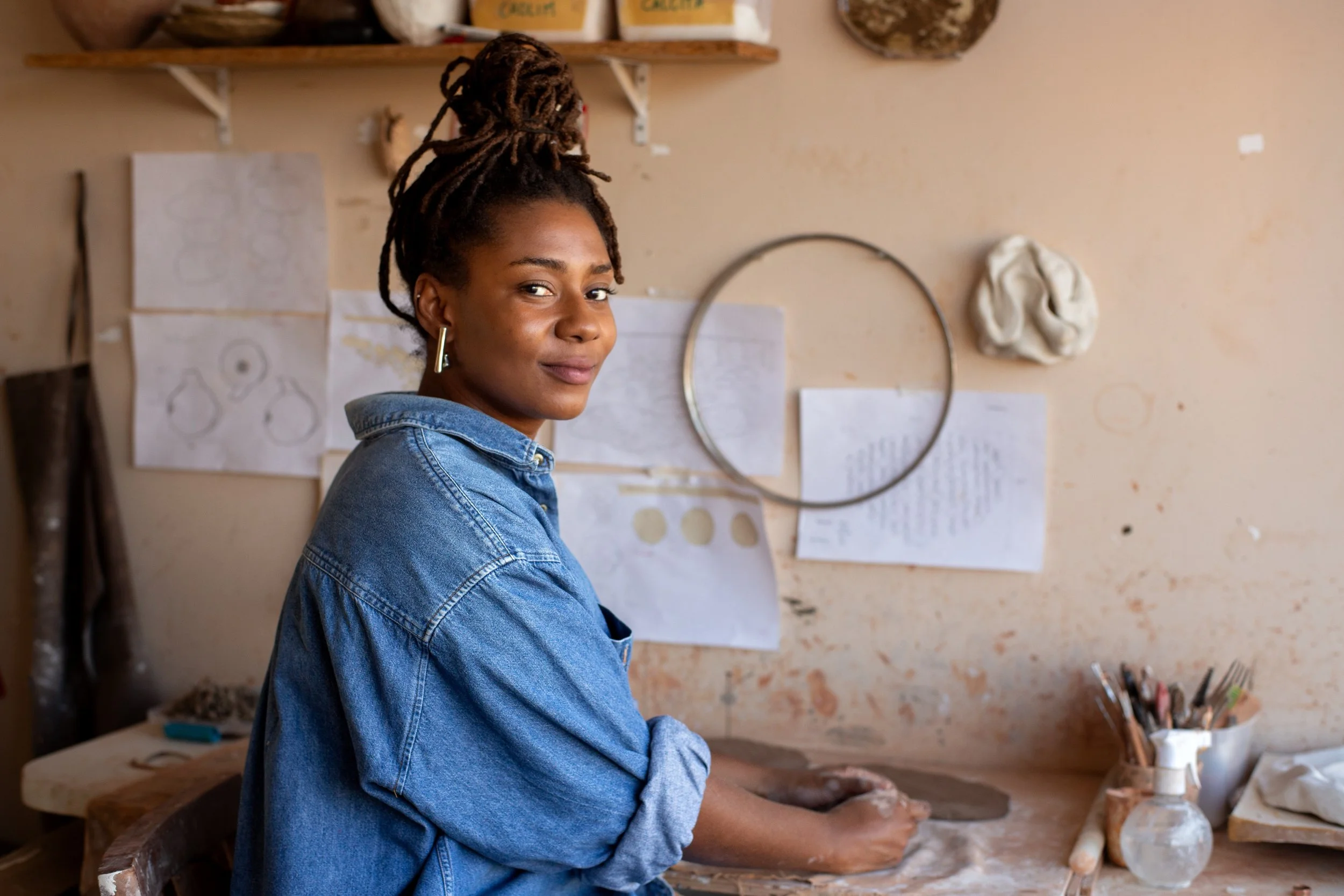
Gabriella Marinho is an interdisciplinary artist who lives and works in São Gonçalo, Rio de Janeiro. Drawing from her background in journalism and African Literatures, she works with clay, earth, and soil as both material and conceptual foundations for an exploration of body, territory, ancestry, and memory.
Across sculpture, installation, painting, and performance, Marinho creates organic and abstract forms that reflect Afro-Brazilian and Afro-diasporic experiences. Her practice is rooted in the landscapes she researches and encounters, often beginning with the collection and study of soils from specific places. These materials are transformed into earthen pigments, terracotta sculptures, ceramic structures, and tactile installations that hold intimate connections to geography, cultural memory, and belonging.
For Marinho, earth is not simply a medium but a living archive. Soil carries the histories of the territories from which it is gathered, including traces of migration, labor, displacement, survival, and transformation. By bringing these materials into the studio, she creates works that connect personal and collective histories while considering the relationships between human bodies and the environments they inhabit.
Alongside her studio practice, Marinho is actively engaged in art education and collective learning. Her pedagogical work brings artistic creation into dialogue with environmental knowledge and community experience, creating spaces in which material experimentation can become a means of exchanging cultural knowledge and strengthening relationships to place.
Marinho has participated in artist residencies in Taiwan and Angola. She was nominated for the PIPA Prize in 2023 and recognized by MOOC100 as one of Brazil’s ten emerging Black artists. Her work has been presented at institutions and galleries including Galatea, Sesc Pompeia, Museu de Arte do Rio, Museu Nacional da Cultura Afro-Brasileira, Centro Cultural Banco do Brasil, and Taipei Artist Village.

Gabriella Marinho’s multidisciplinary practice is grounded in clay, earth, and soil as both material and philosophical foundations. Working across sculpture, installation, painting, and performance, she investigates the relationships between body, territory, ancestry, nature, and collective memory through an Afro-Brazilian and Afro-diasporic lens.
Her process often begins outside the studio through the observation, collection, and study of soils gathered from the places she visits, researches, and inhabits. Each material carries the geological and cultural particularities of its environment. Differences in color, texture, mineral composition, and behavior become points of departure for works that consider how knowledge and memory are embedded within the land.
Marinho approaches earth as an archive capable of holding histories that are not always preserved through written or institutional records. Soil becomes a witness to migration, forced displacement, agricultural and domestic labor, ecological change, and the formation of communities. By transforming gathered earth into pigment, clay, and sculptural form, she creates a material language through which these histories can be encountered through touch, surface, weight, and spatial experience.
Her sculptures frequently take the form of organic, bodily, or vessel-like structures. While abstract, they evoke internal organs, seeds, geological formations, protective enclosures, and ancestral objects. These forms resist fixed interpretation, moving between the human body and the landscape and suggesting that neither can be understood in isolation from the other.
In her paintings, earth pigments produce surfaces marked by variations in density, absorption, and texture. Rather than attempting to control these qualities completely, Marinho allows the properties of each soil to guide the development of the work. Color emerges directly from the land, positioning the landscape not merely as a subject of representation but as an active participant in the act of making.
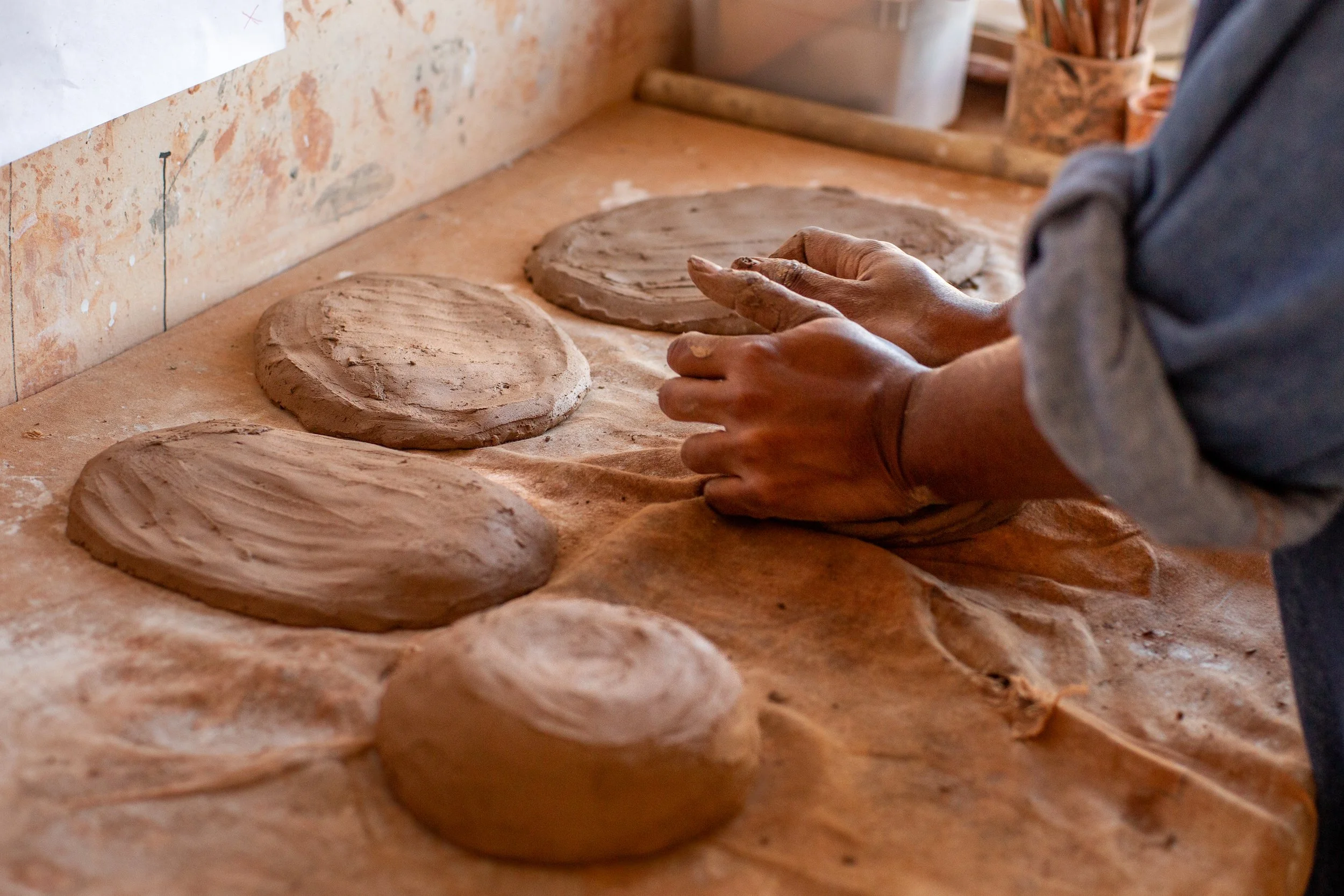
Central to Marinho’s philosophy is an understanding of clay as a living technology and a repository of ancestral knowledge. Largely self-directed through sustained research and experimentation, she works with hand-building, coiling, terracotta firing, engobe application, and earth-based painting. Her methods foreground touch, repetition, physical effort, and the irregularities of handmade form, allowing evidence of the artist’s labor and the material’s behavior to remain visible.
Through this approach, Marinho challenges historical hierarchies that have separated ceramics from other forms of contemporary artistic production or dismissed clay-based practices as primarily functional or decorative. She instead positions clay as a critical and intellectually expansive medium through which questions of race, ecology, identity, history, and Afro-diasporic knowledge can be articulated.
Her practice also extends beyond the production of individual objects. Through education, workshops, and collective experimentation, Marinho creates environments in which artistic practice becomes a shared process of inquiry. These exchanges connect material knowledge with community memory, encouraging participants to consider their own relationships to land, environment, and inherited forms of knowledge.
The Eden Arts Foundation’s support, together with Marinho’s residency at The Elizabeth Foundation for the Arts, will enable her to expand the material and conceptual dimensions of her practice. During her first residency in the United States, she will deepen her research into ceramic processes, encounter new soils and landscapes, and engage in dialogue with artists and practitioners working across contemporary ceramics and the broader field of material-based art. The residency will provide a pivotal opportunity to develop new work while extending the geographic and cultural conversations already central to her practice.
-
![]()
Meter & Light: Night (2025)
Performance still
Image courtesy of the artist, Photo: Tori Mumtaz
-
![]()
Meter & Light: Day (2024)
Recess, New York
Image courtesy of the artist, Photo: Manuel Molina Martagon
-
![]()
Meter & Light: Night (2025)
The Shed, New York
Image courtesy of the artist, Photo: Tori Mumtaz
-
![]()
Meter & Light: Night Performance Ensemble (2025)
The Shed, New York
Image courtesy of the artist, Photo: Ahad Subzwari
-
![]()
Meter & Light: Day (2024)
Recess, New York
Image courtesy of the artist, Photo: Manuel Molina Martagon
-
![]()
Meter & Light: Night (2025)
The Shed, New York
Image courtesy of the artist, Photo: Tori Mumtaz