

Yifu Liu
From West to East and Back Again:
The Re-Europeanization of Chinese Jesuit Imagery in Late 19th Century
As a scholar focusing on the cross-cultural exchange between East and West in the early modern period, I have always been fascinated by the Jesuit mission in China in the 18th and 19th century. Not only did the Jesuits bring Western artistic practices and pictorial conventions to the Qing court, but also they sent back to Europe a wealth of paintings and printed images depicting Chinese culture. These visual materials epitomize the hybridization of two cultures and highlights the entangled network of global communication. My research examines in particular on the understudied history of the Tushanwan Painting Academy, founded by Jesuits in Shanghai in the mid-nineteenth century. The present paper, which constitutes the first chapter of a larger project developed during my fellowship at the Ricci Institute for Chinese–Western Cultural History, seeks to address this scholarly lacuna. Initially presented at the International Symposia on Jesuit Studies in 2022, this study is the first step toward an upcoming exhibition dedicated to the history and artistic legacy of Tushanwan.
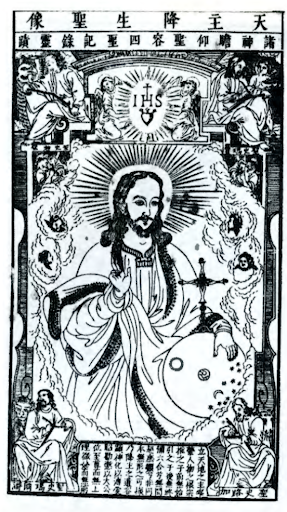
In the early 17th century, Jesuit missionary Giulio Aleni published a wide range of theological works in Chinese to facilitate conversion in Southeastern China. His chief work, The Life of God, the Savior, from the Four Gospels in eight volumes, first printed between 1635 and 37, was accompanied by a separate book, named Holy Images of the Heavenly Lord, which contained 57 woodcut illustrations depicting various narratives regarding the life and deeds of Jesus Christ. These images were executed by Chinese artisans based on the engravings from Jerome Nadal’s Evangelicae Historiae Imagines published in Antwerp in 1593 (fig. 1). Aleni’s pioneering work was among the most influential Jesuit publications in China, which continued to be reprinted and used by the missionaries. Most notable was his investment in images as an effective tool to communicate religious ideas to a foreign audience.
In 1884, Jesuit Bishop Valentin Garnier of the Jiangnan region commissioned a new compilation of Aleni’s works, which was to be sent to the Vatican in celebration of the 50 years of Pope Leo XIII’s priesthood. In the next three years, the project was carried out by the printing press at the Orphanage of Tushanwan in Shanghai, with designs supplied by the students at the adjacent painting studio. Home to various workshops, the Jesuit orphanage would later evolve into the first Western art academy in China, as well as a major publishing and manufacturing center. The Chinese artists created over 300 woodcut prints for the latest edition. While 110 of them were made after Nadal’s engravings, the rest were borrowed from an eclectic group of European sources. First intended as a diplomatic gift to the Pope, this new edition, named The Essential Writings on the Origin, subsequently became a huge commercial success in China (fig. 2). The images gained particular popularity, appearing in several later publications, as well as in other Asian countries.
This paper examines the changes and additions the 19th-century Chinese artists made to the illustrations included in Aleni’s work. Scholars have often referred to Aleni’s prints as an example of Sinicization, a process in which European images were transformed through Chinese artistic techniques and taste. These “hybrid” images speak to the missionary strategy of accommodation and adaption, a strategy that had contributed to both the success and the downfall of the Jesuits in China. When they were allowed to resume their activities in China in 1841, the Jesuits sought to revive such a strategy by focusing again on local education and conversion. However, the later artists took a drastically different approach to the illustrations. Not only did they correct the mistakes made by the earlier generation due to the unfamiliarity with perspective and cross-hatching modelling, but also they simplified the intricate designs of the original prints to better suit the woodcut medium. They eliminated the ostensibly Chinese features from Aleni’s work, and rendered the physiognomy of the figures much more European. In addition, the artists displayed a much more comprehensive knowledge of Western art, making reference to many European paintings and prints.
The analysis of the prints would hopefully make clear the intentions of the Jesuits in re-making Aleni’s 17th-century publication more than two hundred years later. I would argue that the updated version of Aleni’s work speaks to not only the political strategies of the Jesuits, but also the ambition of the Tushanwan Orphanage to establish its reputation as a Western art academy and studio, which would attract more commissions from the Europeans and Chinese alike. By understanding the afterlives of the Evangelicae images in China, one may also pose challenges to the assumptions scholars have made regarding Aleni’s prints, that they were intentionally “Sinicized” to appeal to the local audience.
The Tushanwan Orphanage (fig. 3) has largely evaded scholarly attention until recent years. As letters, journals, and other archival documentations began to resurface, historians have come to recognize its significance to the development of Western art in China in the Late Qing era. In 1851, Spanish Jesuit Joannes Ferrer founded a Western art school in the Xujiahui district in Shanghai, where the Tushanwan Orphanage was located. In 1864, his Chinese disciple Lu Bodu officially relocated the school into the orphanage, where homeless boys were taught the techniques of European painting, sculpture, woodcarving and metalwork. Supervised by their masters, these young craftsmen would produce mainly religious works of art and liturgical objects to furnish churches in China. They also collaborated with printmakers and other artisans at the Orphanage. The collaborative enterprise in Tushanwan would soon expand to include the production of books, stained glass, interior decorations, hardware, musical instruments, collotypes, and other photographic prints.
The students were trained in the manners of Western art academies: they would first make pencil drawings and watercolors using pattern books and prints brought from Europe, after which they would sketch after plaster casts and make portraits of real models (fig. 4). Unlike their predecessors in Beijing, whose artistic output was strictly determined by the demands of the emperors, the Jesuits in Shanghai enjoyed much more freedom and created mainly religious art to serve the mission. They were not required to integrate western techniques and styles into the Chinese tradition. Rather, as scholars have observed, their main goal was to create works of art that could rival with those in Europe in order to gain commissions. As a French visitor noted in the early 20th century, the quality of the works in Tushanwan was “as good as those in Paris.” In particular, the art school made replicas of famous oil paintings in Europe, which fetched exceptionally high prices in the Chinese market. Not limited to a local audience, the paintings and sculptures produced by the orphanage were also sent to France, Italy, and even the World Expo in San Francisco.
These Chinese artists were responsible for remaking Aleni’s books. Their supervisor, Liu Bizhen, who succeeded Lu Bodu, documented the commission in his journal entry titled “Notes on Bishop Garnier’s Gift to the Pope.” As Liu stated, upon the request of the bishop, he instructed his disciples to create designs for the illustrations. He mentioned specifically the origins of the images, that 110 of them were imitations of Nadal’s original engravings, and the rest were “selected broadly from various masters.” Meanwhile, Liu did not refer to Aleni’s “Sinicized” illustrations as models. His comments were paraphrased in a second preface to the final printed volumes by a French Jesuit superior Louis Gaillard, titled “Notes on Images”. In almost the same words, Gaillard traced the origins of the illustrations back to Nadal. He concluded the paragraph by saying, “fearing that those who read this book do not know where the images came from, I thus discuss it here in the preface.” In the 17th-century preface, Aleni briefly mentioned that, in order to explain abstract ideas and to allow readers to visualize the presence of God, the images were “copied by Chinese artists to the best of their ability from Western books.” The 19th-century artists, on the other hand, seemed to be much more aware of the origin and history of the images. As I would argue, the later artists’ decision to not simply copy Aleni’s illustrations was related to both the political strategies of the Jesuits, and the pedagogy of the burgeoning art school.
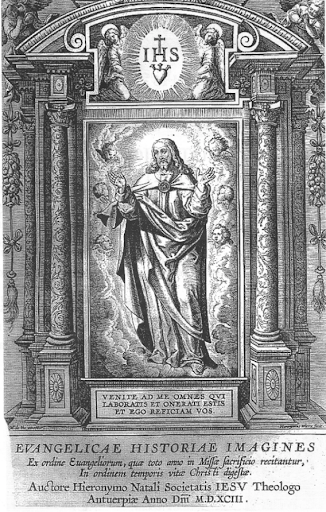
Jerome Nadal, Evangelicae Historiae Imagines, 1598
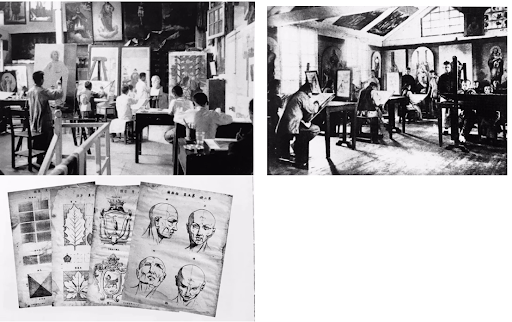
Archival Photographs of the Tushanwan Art Academy in early 20th century
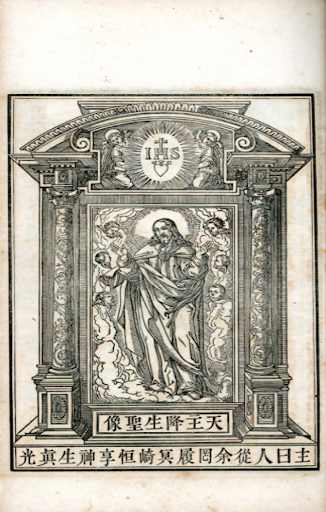
Garnier, ed., The Essential Writings, 1887.
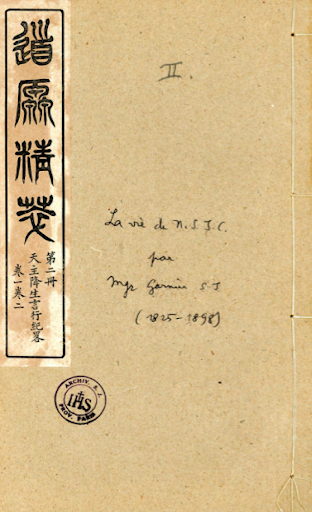
Valentin Garnier, ed. The Essential Writings on the Origin, 1887 (produced by the workshops in the Tushanwan Orphanage), This edition is part of the collection at The Ricci Institute, previously belonging to the Jesuit Archive in Paris.
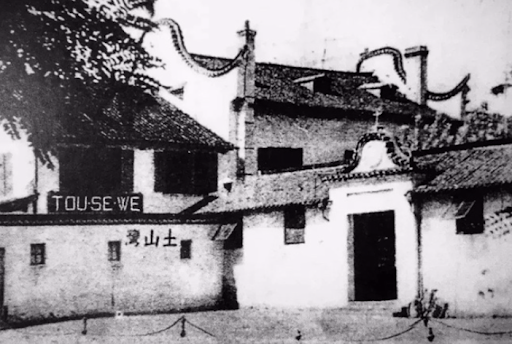
Tushanwan Orphanage in early 20th century
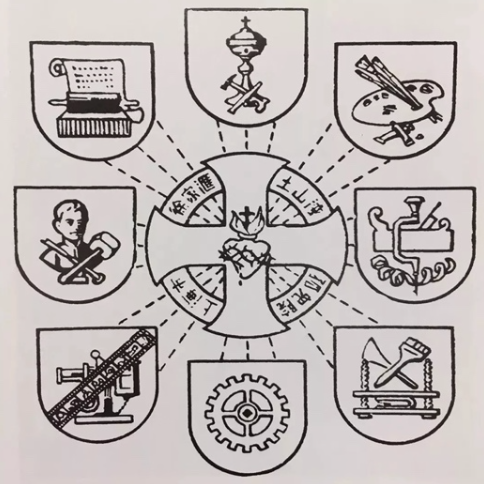
Tushanwan Orphanage in early 20th century
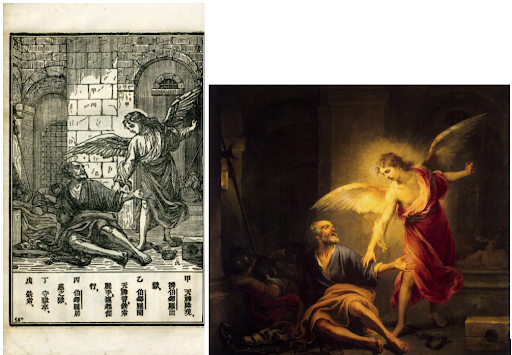
Liberation of St. Peter in The Essential Writings, 1887; Bartolomé Esteban Murillo, Liberation of St. Peter, 1665-67
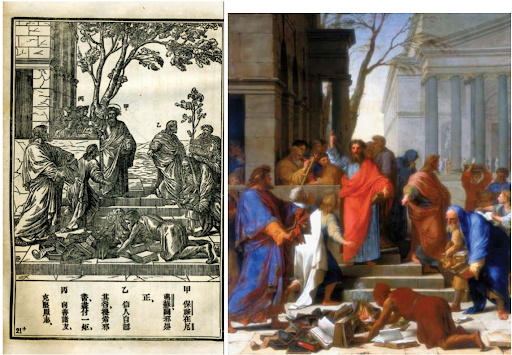
The Preaching of St Paul at Ephesus in The Essential Writings, 1887; Eustache Le Sueur, The Preaching of St. Paul at Ephesus, 1649
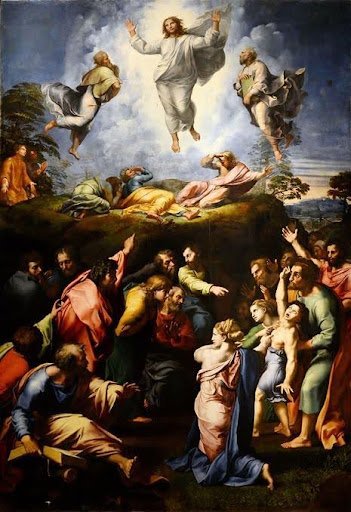
Raphael, Transfiguration, 1516-20, Vatican Musuem
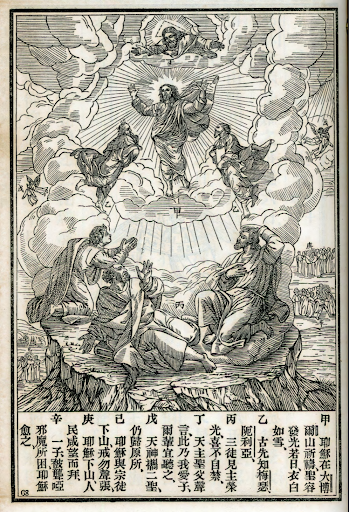
Garnier, ed., Transfiguration in The Essential Writings, 1887
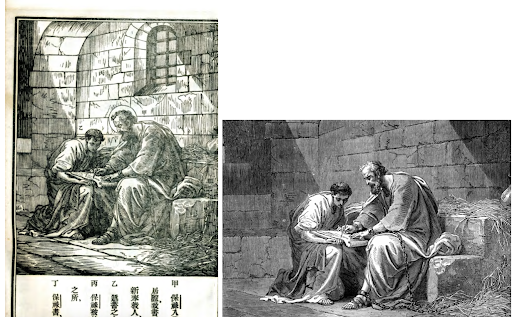
Saint Paul in Prison in The Essential Writings, 1887, Henri Félix Emmanuel Phillppoteaux, Saint Paul in Prison, engraving, 1870s
The first change the artists made was to replace the frontispiece in Aleni’s work with the original version in Evangelicae (fig. 5). Whereas Nadal’s version features a full-length, standing Jesus Christ, Aleni’s version shows a half-length Salvator Mundi. As scholars have observed, the latter integrates the holy image into the Confucian tradition of ancestral portraits. By tying the Christian icon to the indigenous veneration of ancestors, Aleni was able to communicate more effectively the ideas of incarnation, and to establish the sacred nature of the image. This particular Salvator Mundi proved to be quite a success in China and was replicated many times in subsequent publications. However, it was essentially the Jesuits’ adaption to Confucianism that became the focal point in the criticism and accusations of other missionaries, which eventually led to the Papal condemnation of the order in China. It was only logical that the Jesuits would avoid any inklings of Confucian influences in the new version, which was intended as a gift for the Pope.
In the 19th century, printed images from the West had proliferated the Chinese market, and the local audience had been exposed to a much wider range of European works of art. The founders of the Tushanwan art school had certainly used model books and prints in the education of Chinese artists. While Nadal’s images still served a central role, the orphanage artists began to incorporate other European models into the new edition. As mentioned before, Nadal’s engravings were deemed too complex for the woodcut, and they often contained too many narratives in one picture. The Chinese artists thus looked for other images as models, and even developed their own compositions. The Annunciation, for instance, presented particular challenges for Aleni’s artisans, such as the depiction of the clouds, the rays of light, and the architecture. The 19th-century artists abandoned completely Nadal’s model. Instead, Virgin Mary and Gabriel were situated in a classical space, under God the Father and the Holy Ghost. While the composition is new, there are no Chinese features. More interestingly, in an undated, single sheet from the Orphanage printing press, another European design of the Annunciation was directly pasted over the Aleni version, which could have been an experiment that led to the finished version (fig. 8).
The first change the artists made was to replace the frontispiece in Aleni’s work with the original version in Evangelicae (fig. 5). Whereas Nadal’s version features a full-length, standing Jesus Christ, Aleni’s version shows a half-length Salvator Mundi. As scholars have observed, the latter integrates the holy image into the Confucian tradition of ancestral portraits. By tying the Christian icon to the indigenous veneration of ancestors, Aleni was able to communicate more effectively the ideas of incarnation, and to establish the sacred nature of the image. This particular Salvator Mundi proved to be quite a success in China and was replicated many times in subsequent publications. However, it was essentially the Jesuits’ adaption to Confucianism that became the focal point in the criticism and accusations of other missionaries, which eventually led to the Papal condemnation of the order in China. It was only logical that the Jesuits would avoid any inklings of Confucian influences in the new version, which was intended as a gift for the Pope.
Besides religious and cultural motivations, the artisans Aleni employed also added Chinese features to the illustrations due to the lack of knowledge about Western art. They were not entirely familiar with the concept or visual vocabulary of perspective and chiaroscuro. Intricate cross-hatching in the engravings that meant to convey shadow and volume often was lost in translation. For instance, in the Nadal engraving of Jesus Heals Peter’s Ailing Mother (fig. 6), the artist used cross-hatching to depict shadows in the interior of the house, such as on the wooden beam over the figures, on the back wall, and over the entrance. However, the Chinese artists interpreted the shadow on the beam as polychrome paint, which was prevalent in Chinese architecture, and added bricks on the back wall, and a lattice plaque on the door. None of the figures had any shadows, and they depicted the landscape in a manner similar to Chinese ink painting. In the 19th-century, all of the Chinese features were eliminated. They also drastically simplified the design, using fewer horizontal lines to delineate shadow and texture, which was more suitable for the woodcut. In addition, the physiognomy of the figures was much closer to those in the original engravings. Similar changes were made to many of the images. For instance, in Washing of the Feet (fig. 7), Aleni’s artisans added latticework and landscape painting screens to the back wall, and they made mistakes in the foreshortening of the bricks over the entrance on the right. The later Chinese artists eliminated these features, which indicates that they must have copies of the original Nadal prints in order to make these changes.
In the 19th century, printed images from the West had proliferated the Chinese market, and the local audience had been exposed to a much wider range of European works of art. The founders of the Tushanwan art school had certainly used model books and prints in the education of Chinese artists. While Nadal’s images still served a central role, the orphanage artists began to incorporate other European models into the new edition. As mentioned before, Nadal’s engravings were deemed too complex for the woodcut, and they often contained too many narratives in one picture. The Chinese artists thus looked for other images as models, and even developed their own compositions. The Annunciation, for instance, presented particular challenges for Aleni’s artisans, such as the depiction of the clouds, the rays of light, and the architecture. The 19th-century artists abandoned completely Nadal’s model. Instead, Virgin Mary and Gabriel were situated in a classical space, under God the Father and the Holy Ghost. While the composition is new, there are no Chinese features. More interestingly, in an undated, single sheet from the Orphanage printing press, another European design of the Annunciation was directly pasted over the Aleni version, which could have been an experiment that led to the finished version (fig. 8).
This design, featuring just two large figures in a simple setting, was copied directly from Die Bibel in Bildern by Julius Schnorr von Carolsfeld, first published in 1855. Initially a success in Europe, the German illustrator’s work could have travelled to Shanghai via the British merchants. The woodcut prints would also have been an ideal model for the Chinese artists. Indeed, his book became a major inspiration for the new Aleni. For instance, Schnorr’s The Miracle of the Crippled Beggar, and many of his images depicting narratives from the Old Testament, and the Life of the Apostles, were copied in the Chinese volumes (fig. 9). Meanwhile, the reason why the Jesuits focused particularly on Schnorr’ book remain to be investigated.
In creating the illustrations, the Jesuits indeed “selected broadly” from a wide range of models. For instance, the Chinese artists replaced the upper half of the Transfiguration composition in Evangelicae with figures based on the painting of the same subject by the Raphael (fig. 10). They copied the painting by Eustache Le Sueur called The Preaching of St Paul at Ephesus (fig. 11), as well as Liberation of St. Peter by Bartolomé Esteban Murillo (fig. 12). They also copied the design of Saint Paul in Prison by Henri Félix Emmanuel Phillppoteaux (fig. 13). The sacred heart imagery, popularized by Pompeo Batoni in the 18th century, was also present throughout the volumes. There is no apparent logic to the models the Chinese artists used, as they were not limited to any specific period, location, or religious confession. It was instead a demonstration of the artists’ ability to copy European works of art, which constitute a large part of the business at the Orphanage art school. While they adjusted the composition to fit the format of the book, there is not a single attempt to adapt the images to Chinese artistic traditions.
“Sinicized” religious images did not cease to exist in 19th-century China. In fact, the Tushanwan artists also received commissions to create images of holy figures dressed in Chinese garments or in Chinese settings. For instance, the iconic image of Our Lady of China, showing the Virgin and Child dressed in Chinese imperial garments, was created by the Liu Bizhen in 1904 based on Katherine Carl’s portrait of Cixi. Yet despite the fact that Aleni was among the first missionaries to introduce such hybrid images to the Chinese audience, the new edition of his works displayed no such characteristics. Having understood the origins of the prints and equipped with more refined techniques, the later artists saw these Chinese features more as misinterpretations and unnecessary details. They sought to elevate the quality of the work by making more accurate copies of the Nadal originals and other European masterpieces, while simplifying the cross-hatching rendering to suit the woodcut medium. On the one hand, one must take into consideration the intended audience. Since it was a gift for Pope Leo XIII, the new edition was to be viewed in Europe. Naturally the artists would want to cater to the European taste, and to avoid any signs of excessive cultural adaptations that had stigmatized the Jesuits centuries earlier. Meanwhile, one must ask whether Aleni intentionally Sinicized his illustrations to appeal to the locals. There is no indication that the Chinese preferred the hybrid images. In fact, the subsequent success of The Essential Writings in China suggests that the local converts embraced these European images. The absence of Chinese features did not undermine the effectiveness of the illustration.
On the other hand, the new edition was a testament to the achievements of the Tushanwan art school. It was in the process of creating religious images and sculptures based on European models that the orphanage became the cradle of the first Western art academy in Shanghai. The students in Tushanwan later became foundational figures in the development of Chinese art from the Late Qing period to the modern era. The re-Europeanization of these Jesuit images can thus be understood from several perspectives. Firstly, the images journeyed from the West to China, and were remade by the Chinese artists and sent back to Europe. Secondly, they were once remade by Chinese artisans, resulting in hybrid forms, and were modified once again based on new European models. Continuing research on such an example would further illuminate the complexities regarding the dissemination of images in a global context. One must take into consideration a variety of political, cultural, and commercial factors to engage with image through time and space. Hybridization alone can no longer account for the many ways in which images are transformed.