

Whitney Allison Oldenburg & Richard Vine
Waste not, Want not
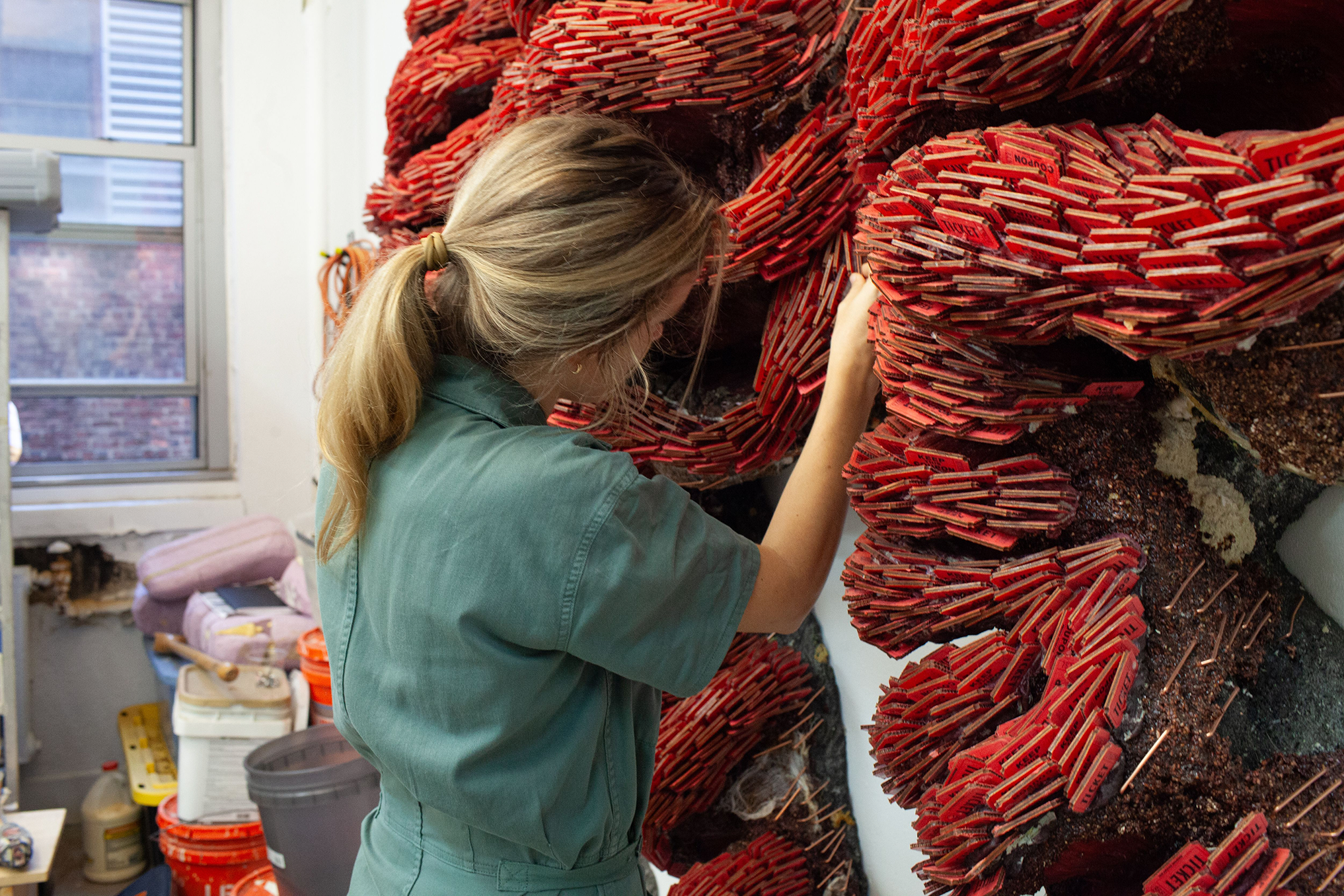
“On or about December 1910,” Virginia Woolf wrote about the advent of modernism, “human character changed.” One could say, a bit more modestly, that artist Whitney Allison Oldenburg addresses issues that are unique to our time—indeed that reflect a fundamental change in the life of our species. For some 300 millennia, the human race evolved in a condition of scarcity. Even when food and shelter were occasionally abundant, the great majority of humankind lived season to season, year to year, ever fearful of drought, crop failure, flood, fire, blizzard, war, pestilence, or other disasters. Even when empires provided relative stability, only a governing minority attained luxury, a reliable surplus of goods. But with the Industrial Revolution—only yesterday in historical terms—a large segment of the earth’s population began to experience something entirely new: sustained abundance not only of foodstuffs but of made things, produced in such enormous, unrelenting quantity that waste became a defining characteristic of our age.
“I seek to make art that physically embodies adaptation,” the artist has said. Today, that means primarily adjusting to our own transformation of the natural world.
Oldenburg addresses this condition from the inside, as someone to whom it is native. Born in 1987 in Jacksonville, Florida, she earned her BFA from Cornell University (2009) and an MFA from the Rhode Island School of Design (2015). She has exhibited her paintings, drawings, and sculptures professionally since 2014. Brimming with crude vitality, Oldenburg’s works on paper and canvas feature skewed patterns of irregularly rendered forms: circles, cell-like blobs, spirals, striations, branches, rock shapes. Done in black-and-white or murky blues, browns, and reds, the pictures hover between representation and abstraction, both idioms treated in a messy, lively style. Her abstract sculptures—some destined for floors, some for walls—appear twisted, bent, and pulled, offering scraggy surfaces and large quantities of unorthodox components (lollipop sticks, juggling pins, neckties, credit cards, etc.) to an audience awash in consumerism.
Materiality, surplus, and waste—these are clearly Oldenburg’s constant theme. She has pursued her investigation of how we deal with our rampant, unprecedented production under the auspices of various awards, residencies, and fellowships, most recently at the Elizabeth Foundation for the Arts in New York. Such obsessive focus, continuing for more than a decade, prompts a dual question. How does the artist think about this manufactured bounty? And (most important for our experience as viewers) how does she react to it, physically and visually, in her work?
In several essays and interviews, Oldenburg has cited French theoretical influences, especially Georges Bataille and the Situationist International. In La part maudite (The Accursed Share, 1949), Bataille argued that excess energy, beyond what we need for physiological survival, has been a key factor in social evolution. In the early stages of human development, surplus life-force could be siphoned off into rituals, festivals, gift-giving, art, religious ceremonies, sacrifices, communal architecture, and limited combat. His conceptual paradigm was the potlatch, a binge of tribal gift-giving that venerates waste as a sign of the chieftain’s power. But the modern world, with its stupendous productive capacity wedded to capitalism’s demand for maximum efficiency, explicitly abhors waste, while nonetheless generating it at gargantuan scale. This contradiction, according to Bataille, eventually explodes into forms of domination, imperialism, fascism, and mass warfare. As individuals, we can escape this dilemma only by occasionally freeing ourselves from instrumental reason and giving vent to playfulness, intoxication, eroticism, sport, and other modes of intentional non-productiveness. This “uselessness” Bataille deemed essential to a life of personal “sovereignty.”
Such notions certainly compelled members of the avant-garde Situationist International (1957-72), whose culturally disruptive interventions—precursors to the May 1968 student uprisings in Paris— took inspiration from Guy Debord’s La Société du Spectacle (The Society of the Spectacle, 1967). The group’s de facto leader characterized current social relations as innately inauthentic, since capitalism displaces most real human connections with a continuous stream of icons and imaginative scenarios—all proposing acquisitive ways of being—mediated by advertising, pop culture, and commercially conditioned institutions.
Lying unacknowledged behind this Continental analysis were the insights of American sociologist Thorstein Veblen, whose 1899 book The Theory of the Leisure Class scrutinized “conspicuous consumption” as a maker of social advancement. In France, following Debord, Jean Baudrillard critiqued the hollowness, or “irreality,” of the “simulacra” created by the “society of consumption,” while Julia Kristeva fretted philosophically over the “abjection” inherent in the physical waste that accompanies economic surfeit.
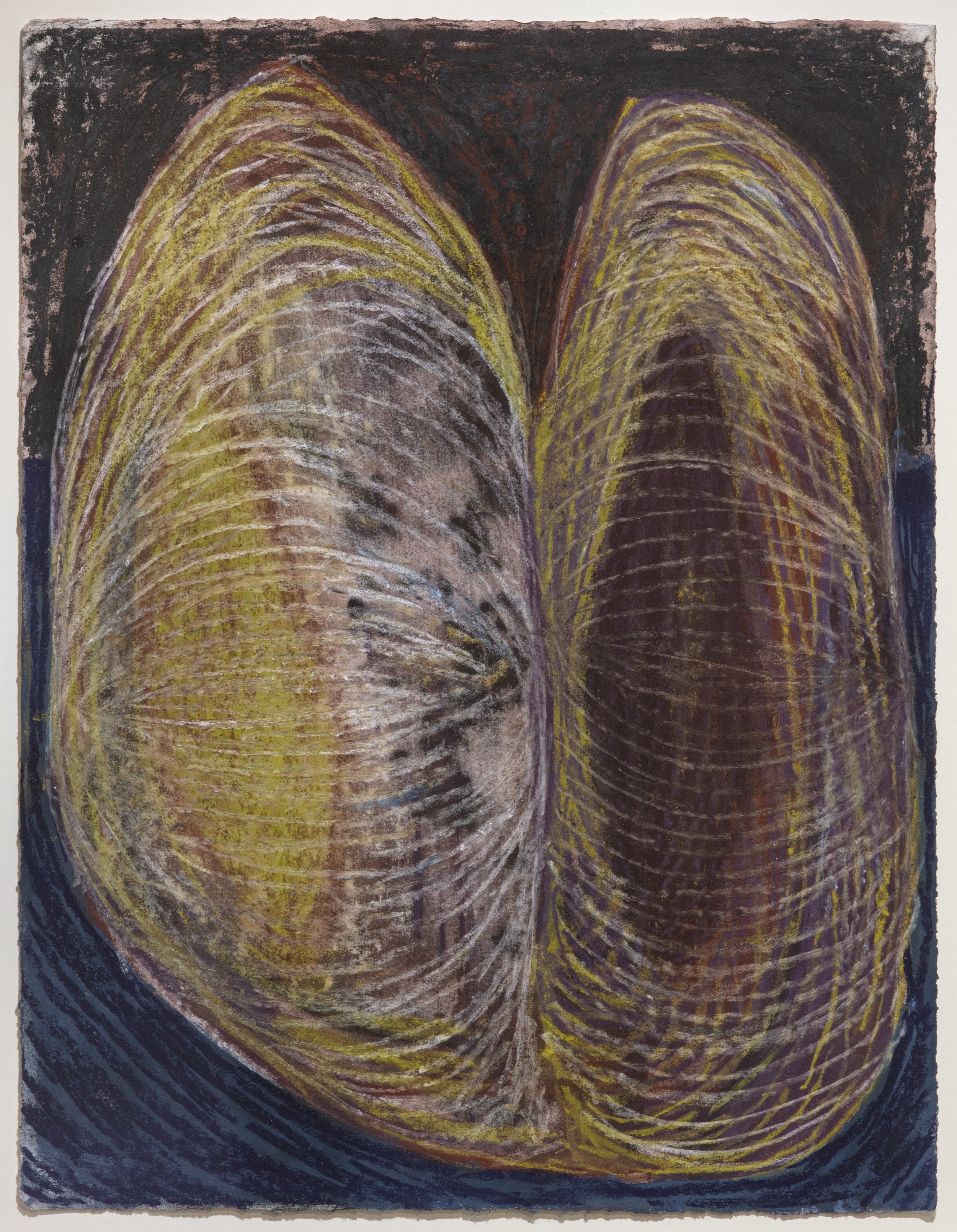
Cocoon, 2024, Charcoal on paper, 26 x 20 in Image courtesy of the artist and CHART Gallery
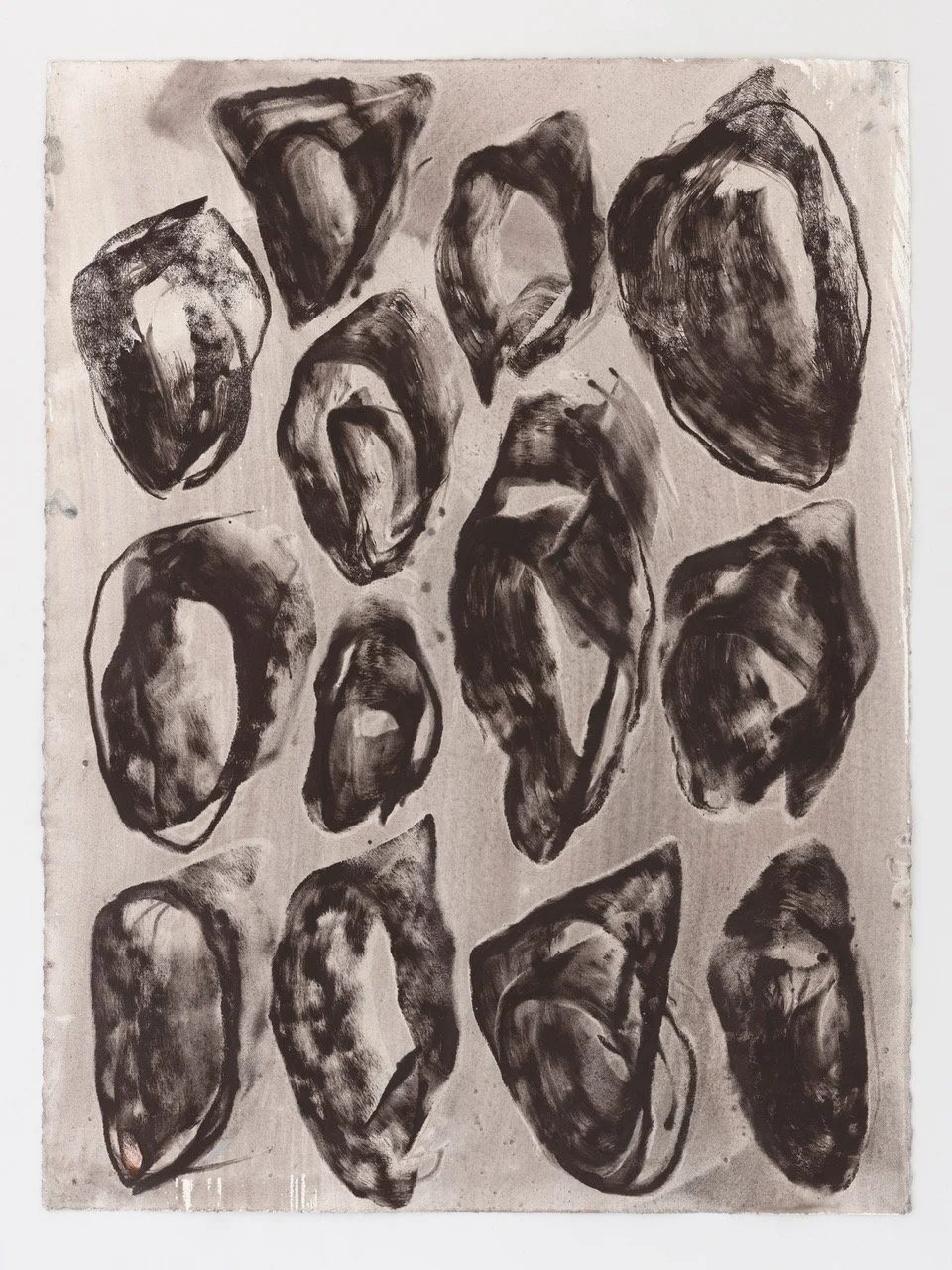
What I hold, 2023, charcoal on paper, 30 x 22 in Image courtesy of the artist and CHART Gallery
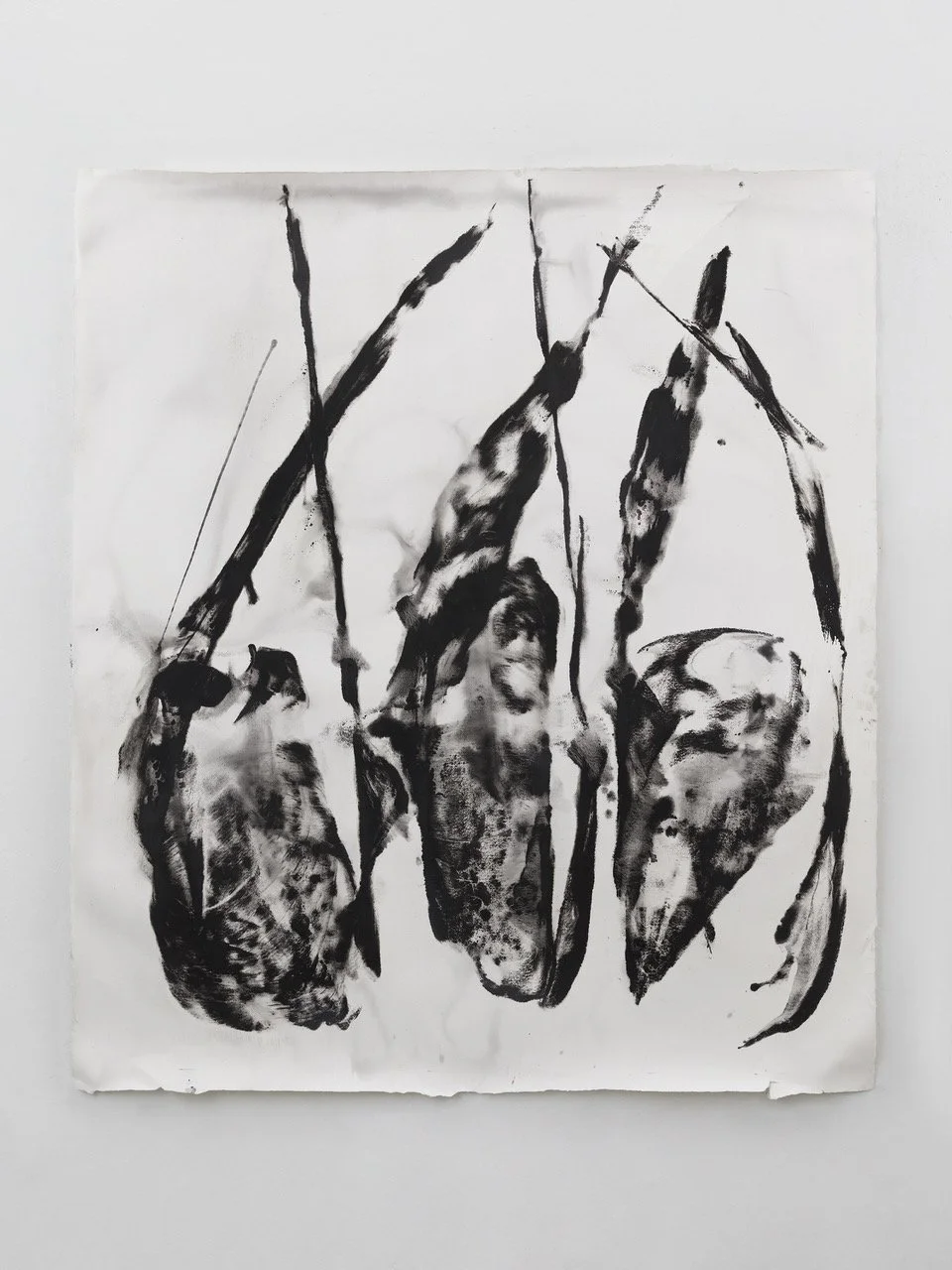
The weak will soon be strong, 2023, charcoal on paper, 51 x 44 1/2 in Image courtesy of the artist and CHART Gallery
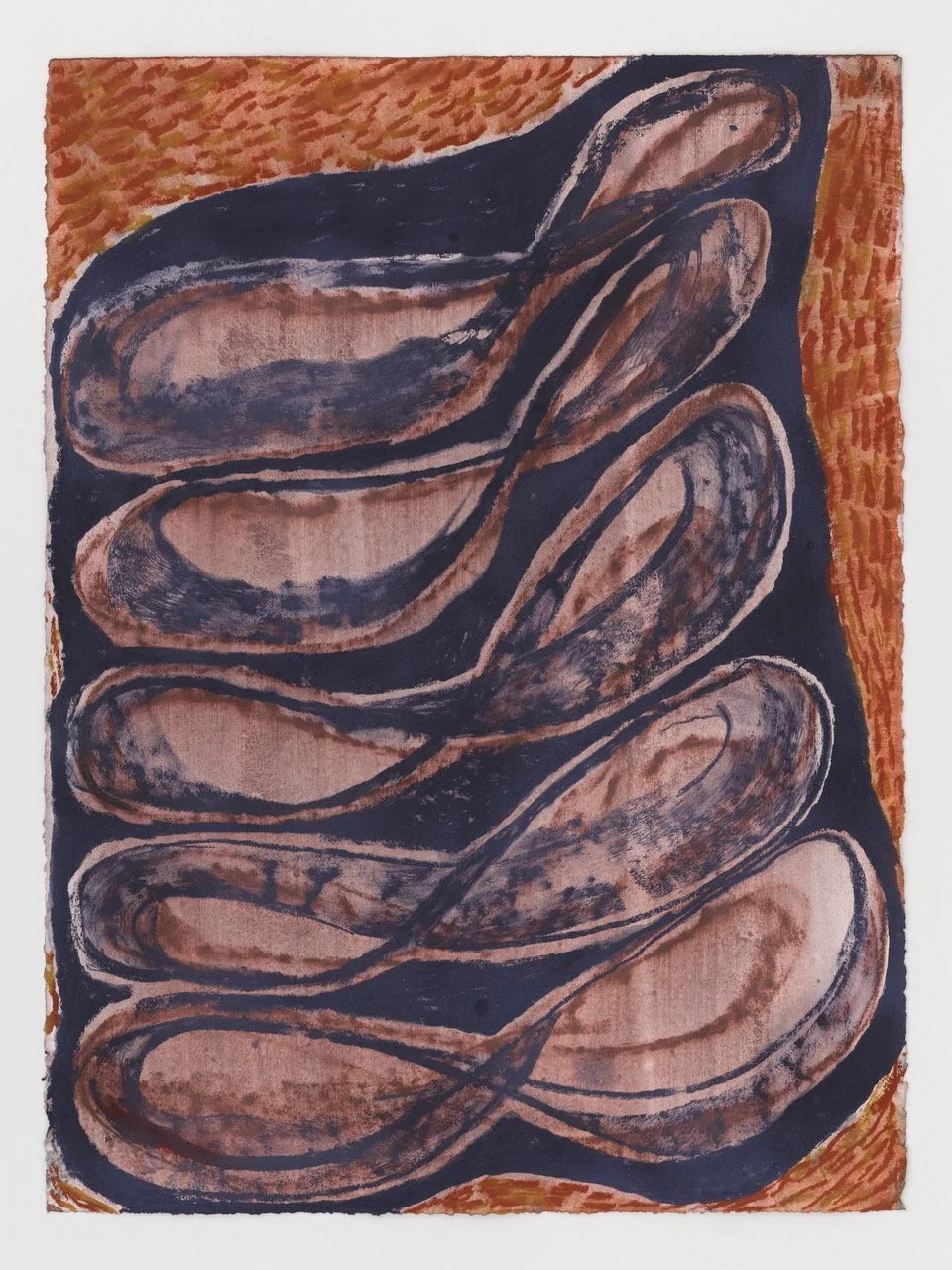
Finding the future, 2023, charcoal on paper, 30 x 22 1/4 in Image courtesy of the artist and CHART Gallery
Why, given this intellectual legacy, does Oldenburg purvey such a rough beauty, a formal control that is firmly shape-guiding but not systematic or absolute? Why do so many of her pieces look extruded, like disdained industrial by-products?
In part, her choice is governed by the critical convention that associates formal roughness with emotional sincerity. Around 1900, Swiss art historian Heinrich Wölfflin changed the interpretation of Michelangelo’s Slaves, those writhing muscular figures still partially encased in marble blocks, designating them not unfinished refuse but intentionally expressive works, a reading taken up by Rodin for his own inchoate figures and subsequently applied to every form of art. Roughness equals honesty and emotional intensity; precision and high-finish bespeak repression—that is the mental calculus that has passed down through the Beats and others to artists and critics today. We often suspect there is something false and close-minded about perfectly refined work. The virtuoso artist, we fear, is restating the already known or believed, not hazarding his soul to adventure.
Oldenburg’s salvage-yard expressionism, on the other hand, combines modernist “truth to materials” with Romanticism’s “truth to feelings.” Her refusal of formal definitiveness, the amorphousness of her objects and images, suggests that our relation with the world is dynamic and therefore perpetually tentative, subject to erasure and change. As biological entities endowed with consciousness—animals acutely aware of our own pleasure and pain, life and death—we can see Oldenburg’s works as emblems of our perpetual flux.
Her core subject is the ambivalence we feel about material abundance and its attendant waste. Freud located the origin of this psychological divide in early toilet training, wherein children, who at first feel only pride and curiosity about the pungent matter they produce within themselves and expel, their first tangible gift to the world, soon learn—at the prompting of adults, of “civilization”—to view it with shame and disgust. This affective opposition generates energy, the charge that drives (among other things) creative endeavors. We cannot settle on a single reaction to waste; instead, we vacillate, our art vacillates, between contradictory poles.
On a societal level, think of the joy in excess, the Nietzschean will-to-power, once betokened by billowing factory smokestacks, by snapshots of hunters and sport fishermen displaying hordes of slaughtered wildlife, by the 19th-century near extermination of the American Buffalo. Only now, since the advent of ecological consciousness, do we look back in horror at the toxic smog hat once hung over Pittsburgh, or the acres of rotting bison carcasses that besmirched the Old West.
And yet our ambivalence remains. The logic of capitalism—based on horror vacui and the illogic of infinite growth—urges us to consume (and therefore to produce) to the point of satiation and beyond. The world must be filled, and the self must be fulfilled, through a plentitude of commercial products. How many times has a picture of jammed American supermarket shelves been used to signify the rightness of our economic imperative? In part, this appeal is tinged with elements of the Sublime propounded in the 18th century by Immanuel Kant and Edmund Burke— an attraction to the at once intimidating and alluring “terribleness” of immense size, power, and mystery. But it carries as well a hint of the child’s—which is to say every human being’s—
secret love of personal bodily secretions,
sublimated, according to Freud, into art: the impulse that prompted Piero Manzoni to can and sign his excrement, Judy Chicago to work with menstrual blood, and Carolee Schneemann to read from a printed strip pulled progressively from her own vagina.
It is a fundamental, ineradicable ambivalence that puts Oldenburg in dialogue with some of the most richly provocative artists of the postwar period: Abstract Expressionism (“What is this shit? My kid could do that”), Asger Jorn and the CoBrA movement, Chicago Imagism, Funk Art, Eva Hesse, Art informel, Yayoi Kusama, Lee Bontecou, Louise Bourgeois, Louise Nevelson, Kiki Smith, Arte Povera, Mary Kelly, Paul McCarthy, Michael Landy, Subodh Gupta, Anicka Yi—there is an entire compare-and-contrast dissertation waiting to be written. Key to this dialogue is Oldenburg’s respect for the affection, conscious or unconscious, that many people feel toward certain substances and objects. Think, she urges us, of children’s attachments to teddy bears, or adults’ gratitude to material things that facilitate our daily lives (e.g., the air filters in Hopes and Dreams, 2023), alleviate our distress (the Tylenol capsules in High Tide, 2023 ), or give us pleasure (the coffee grounds in The Old Ones, 2025).
In one sense, Oldenburg’s work chimes with the traditional Japanese wabi-sabi aesthetic, which finds beauty and a hint of worldly wisdom in things that are old, imperfect, broken, or visibly repaired—the most vivid example being shattered pottery that is restored with veins of gold conjoining the fragments. (“The world breaks everyone,” Hemingway wrote, “and afterward many are strong at the broken places.”) The difference is that Oldenburg makes her trash elements into something other than the original, something artistic and new yet disconcertingly familiar. Thus Body Brace (2021) incorporates doormats; Apex Predator (2023), cell-phone cases; Fade (2023), remote controls, etc.
Oldenburg, highlighting her method’s imaginative fertility, calls it “an erotics of accumulation.” But there is no eroticism without raunch—without “filth,” literal or metaphorical. What to do about our inevitable spillage of both energy and substances, and about the ambiguity—at once exultant and rueful—we feel about it? One option, available to the blessed few, is to make art of our untidy enchantment.
Perhaps this is why Oldenburg’s works evoke gross fluidity but do not actually ooze. They are, in effect, the informe petrified, a reminder that our castoffs—substances and objects, compulsions and dreams—will be with us always and must, therefore, be consciously wrangled. Life is quick; its hard facts, physical and psychic, are too often suppressed into current denial and future catastrophes. But Oldenburg invites us instead to stop, perceive, and take honest stock of the paradox that transfixes us. She is no firebrand but a cultural critic whose observations assume plastic form, an artist who quietly conveys a galvanizing cultural critique.