

Melissa Joseph & Lilly Wei
Talking Art and Life
One of Melissa Joseph’s talents—and she has many—is the ease with which she explains her projects and thoughts, all offered with rare, often disarming candor. Her communicative skills are deceptive. By that I mean that her commentary, while seemingly casual, is deeply informed and considered, conveying the complexity and multiplicity of conversations about contemporary art with clarity and feeling, her responses engagingly personal. A New York-based multimedia artist, her themes are rooted in family history and diaspora, and how that has affected her sense of place, space, and of home, all of which is entangled in the vagaries of politics. Recognition of the work of women is of critical importance to her as is her identity as a mixed-race American and the role that community and human bonding plays in the realization of self.
The following is an edited conversation that took place in her studio on December 8, 2025.
LILLY WEI You are best known for your very unique work using felt and also for your subject matter, which is your family. Let’s talk about that first. When did you begin depicting your family in your work?
MELISSA JOSEPH It was when I was in grad school at PAFA (Pennsylvania Academy of the Fine Arts), after my father died. I am really focused on my Asian heritage, but it took time to evolve since we were expected to assimilate. Right now, diaspora and different cultural heritages are part of the global conversation but it’s also personal for me. It matters that all these different histories are fused into my body. I have photos of India and Pittsburgh all mixed together, and my work also mixes all these images together, because that’s how my world and my life is. These photos, for example, are of my Irish grandparents and this one is my dad at their house at Christmas. It isn’t necessarily about wanting to go back to India (although I do go back to visit my relatives there and am having a show in Kochi, a collateral exhibition of the Biennale, that will be up through the end of March) but about how the Old World exists in the new space.
LW You said you thought that such connections might be transmitted to descendants?
MJ I thought of it like epigenetic information that is passed on. If trauma can be transmitted, then why not good things? That’s the thematic construct for a show in June in London at the Sim Smith Gallery that I’m working on. I think it explains a lot about why we have longings for places that we haven’t been.
LW There is a difference between genetic inheritance and cultural inheritance, and you seem to be talking about both.
MJ I believe that when there are migrations, whether they’re voluntary or forced, it interrupts the passing of that kind of information. Then we need to rebuild the code. I think a lot of artists like me who have immigrant parents or who are immigrants themselves are doing something similar. We’re trying to rebuild the code through the work since the information that would normally be carried by the land or by the people around us is not there when we get dropped into a new place.
LW When you went to Scotland recently to talk to the weavers there, you said it was quite the opposite.
MJ Yes. I met a farmer in Highland Perthshire. He is the third generation in his family to farm this particular land, to tend these particular sheep. He and the sheep are telling the story of the people who have been in those hills for generations. There is a connection to the land, to the history of the space, between everyone I spoke to there in a way that we don’t have access to anymore and I love that, I find it inspirational.
LW Why do you give your Indian heritage precedence?
MJ If you present as non-white, you have no choice. The choice was made for me that my identity was going to be non-white in America. I read Racial Melancholia, Racial Disassociation by David L. Eng and Shinhee Han about the changing processes of loss associated with immigration, displacement, diaspora and assimilation of Asian American young adults. I responded most to the term racial dissociation.
LW And your mother’s family?
MJ We spent every holiday with my mom’s Irish family in Pittsburgh. Another show that I’m doing will be at Charles Moffett in New York in September. I’m calling it Casserole Culture because, honestly, if you ask me who I am, the most that I am is a Pennsylvanian. All this language of rusted things and wooden things are from Pennsylvania. This is my material memory, being drawn to all these rusty objects around me when I was growing up and are the identifying markers of my existence. Also, I’m a non-digital native. Being part of this last generation of non-digital natives is a very significant thing because when my generation dies, there will be no one left who wasn’t born in the digital age.
LW And when you began to make art, what did you make?
MJ I wanted to have a social practice and thought that I should make work about the gun violence in Philadelphia when I was in grad school. But I soon realized that it was not my content. I had never experienced gun violence. I read Christina Sharpe’s In the Wake, which is brilliant and opened up new ways of seeing and being seen, new ways of looking at otherness, and reframing the language. I started to think about what my content was. My father (he was a surgeon) had before and after photos of wounds that he had stitched. They were for insurance purposes, and I remade some of them when he died. They were for my application portfolio for graduate school
LW So the use of family memorabilia as subject matter and stitching as technique began as a tribute to your father?
MJ Yes, but the stitching was taught to me when I was little by my mother who was a cross-stitcher and a crafter. But she didn’t teach me felting. I learned that during COVID.
LW Fairly recently then?
MJ Yes. I’ve explored all other types of textile work and I have a degree in textile design from FIT (Fashion Institute of Technology).
LW What made you gravitate towards textile?
MJ It was what I grew up working with. In a small Rust Belt town in the Mid-Atlantic region, we didn’t have museums, we didn’t have much access to the arts, not even an art store. I took piano lessons and painting classes taught by a nun whom I’m still in touch with at the local convent, part of the oldest Benedictine monastery in the U.S. For seven years I would go once a week to the convent and I would make copies of Bob Ross paintings but I never felt connected to painting on a material level. I love the concept of painting. I love painterly language, I have an emotional connection to it, and I think of myself as an expressionist, but the paint itself is so messy. When I started asking myself questions about painting, it was a bit of a crisis. I could work on paper, but I didn’t care about it. I could work on canvas or a panel, but I didn’t care about that either. Then, when I started to felt, it solved the crisis because suddenly, the image and the material converged and became one thing.
LW These works aren’t wet felted, are they?
MJ I made wet felted images but I am doing needle felt now. I prefer dry mess over wet mess. What I love about needle felt is that I can pick it up and take it with me. It’s portable. I can work anywhere. I can start and stop anytime I want. It’s not a big process to set up or to clean up. I just leave it and then come back to it. It’s very free. I make ceramics also but that’s a different process—and it’s a wet mess!
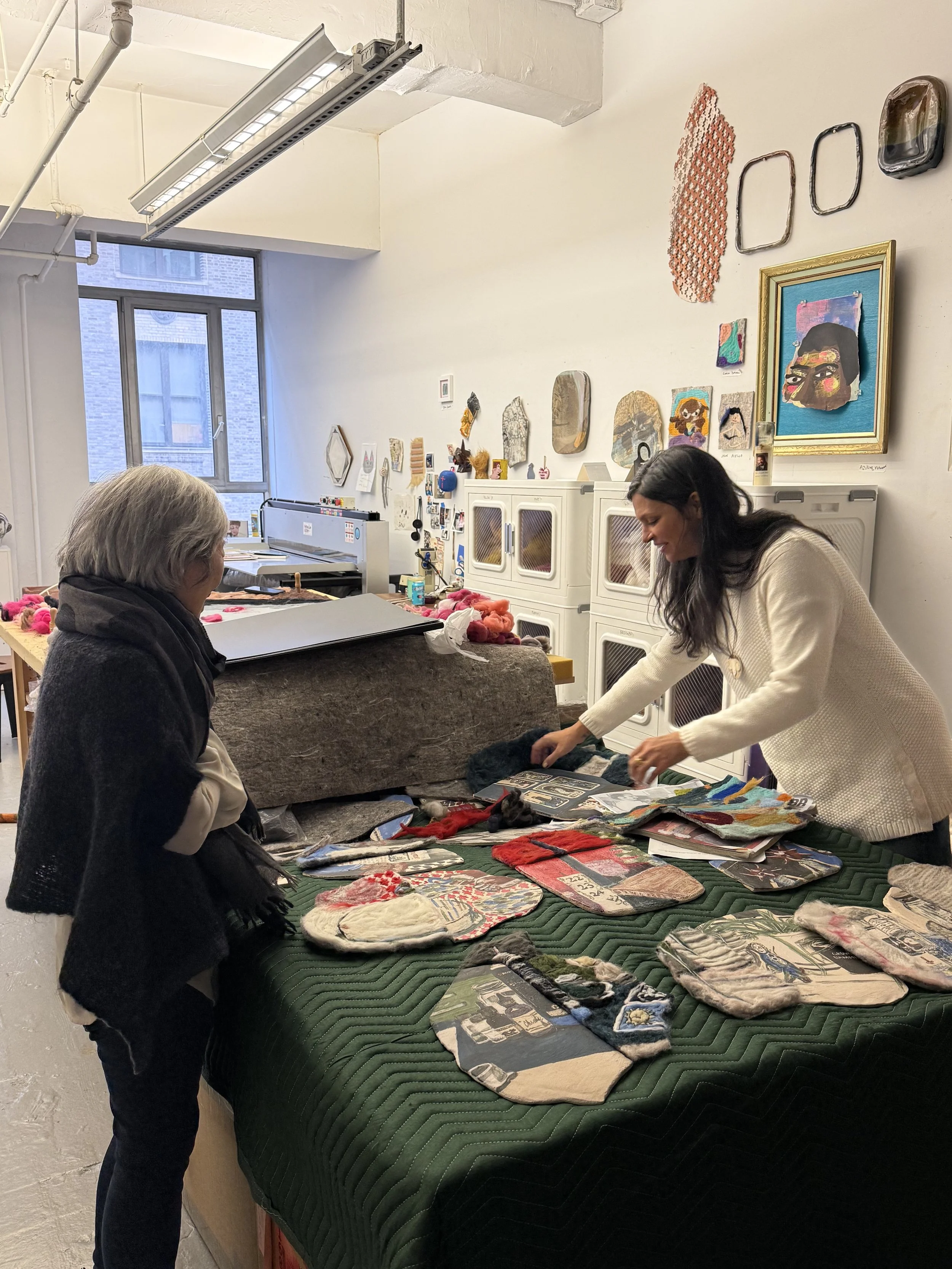
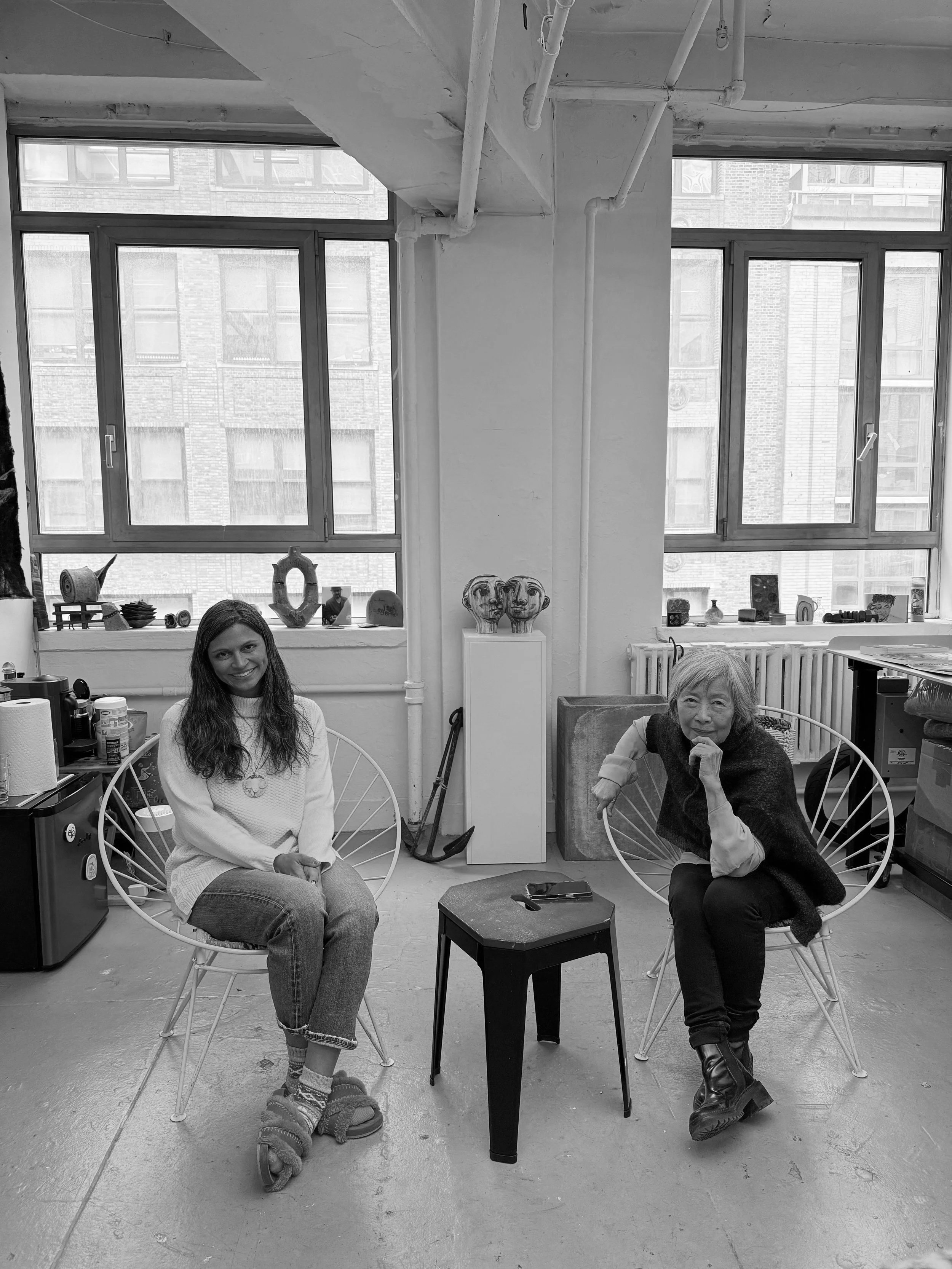
Melissa Joseph and Lilly Wei in the artist’s studio, 2025
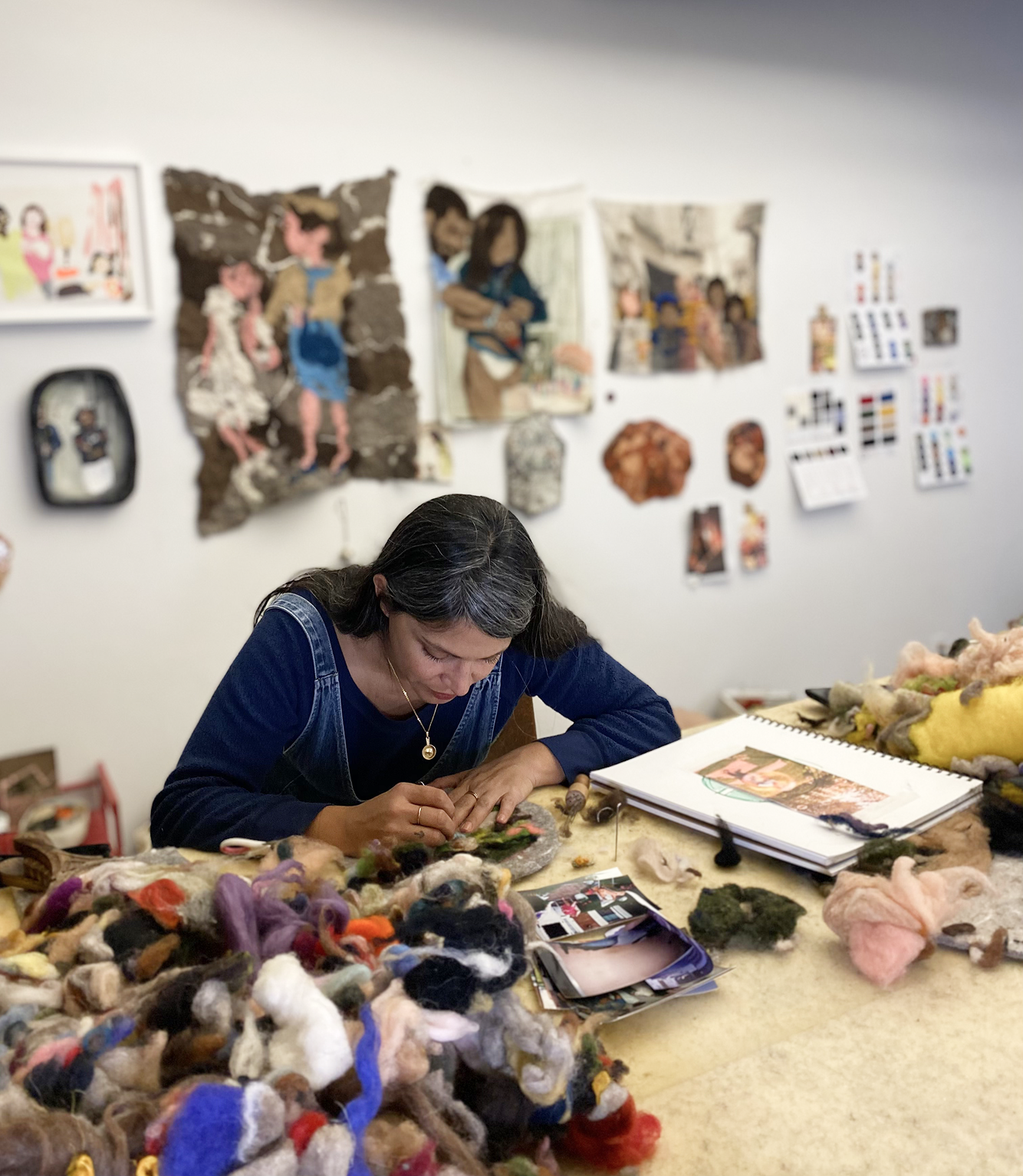
Melissa Joseph working in studio, Photo by Mara Poch
LW You are more of an object maker, aren’t you since most of these felt pieces are low or high-relief, their presentation often sculptural.
MJ I think like an object maker. Even if I’m making two-dimensional work, I’m an object person. And it turns out that I have a social practice after all. I made an image of the celebration of Onam, a South Indian harvest festival from Kerala that my dad used to celebrate. My dad’s family is Christian, so they don’t usually celebrate the Hindu festivals, but this one they do. I made an image for it and I was contacted by the New York school system. They were going to implement cultural modules into their early education classrooms and wanted to use this image as a pedagogical tool.
LW I like the communal aspects of felting, of quilting bees, or other so-called crafts, of women talking, working together, helping each other.
MJ Yes, it’s a magical thing. That, and the communal history of felt, which is so important to me. As soon as we domesticated animals, we were able to protect ourselves, build homes like yurts, make clothing, carpets. And even very early, people were decorating, using felt for design. The process hasn’t changed. It’s connected to time and to the history of humans learning how to survive in this world, imagining what it could be like, working together. I always appreciate the points of view that come from working with other people that I wouldn’t have discovered on my own.
LW The hierarchy of disciplines has shifted lately, don’t you think? Craft is finally being considered more seriously as art in the U.S.
MJ I’m trying so hard to put craft into museums next to paintings. I want to expand the field of painting even more, to push it further, to make textiles equal to paintings. These are humble materials that anybody can access. They are inexpensive and the learning curve is low.
LW Your felt works range in scale but all are relatively small. Have you made large-scale works? Would you make them?
MJ I’d like to make some monumental textiles, a giant, giant thing and just invite people to add to the work like an exquisite corpse made with felt. I’ve thought about a wall that everyone could add to throughout the course of a show. I enjoy doing large work from time to time with a specific purpose, such as the 9 x 12 foot one I did at Artpace in San Antonio in 2024, but I don’t envision myself doing 20-foot paintings on a regular basis. My content is quite intimate, so I don’t think it requires it.
LW You talk about the politics of space, or perhaps the polemics of space. Could you explain what you mean by it?
MJ I realize that I live my life so painfully aware of space and who gets to take up space. I always need to know exactly how I am in the space, how I occupy it. I am always so fascinated by those who don’t have to know, who just move freely through the space. I live in a female body and I don’t know how to do that. I can’t just escape into a different body. Then add to that being from a different ethnic minority. I think a lot about that. I think much of my work is about that, about taking up space.
LW I noted that you talked about rage, a word I’m hearing much more often these days, particularly from women.
MJ I made the mistake of reading the book Invisible Women: Data Bias in a World Designed for Men, by Caroline Criado-Perez. It just made me so angry. Women, for example, are less safe in cars because seat belts are designed for a dominant type of male body, or the size of doorknobs, the height of windows, the doses of medications, everything in the whole world is for men. Anybody who is in a marginalized body, a non-dominant body has to think about that and it extends beyond the physical body. It permeates how you think, who and how you are.
LW Yet you are doing well, aren’t you?
MJ It’s against the odds for sure. Maybe a lot of us feel this way. It was a confluence of conversations about representation, conversations about fibers and craft, conversations about South Asians who have become more visible across the societal spectrum, across all industries. Then there was the COVID bubble that made people buy emerging artists. That wouldn’t necessarily have happened ten years before. And if I were just starting out now, it would be much more difficult, I think. So yes, I would say yes. I think it’s a miracle that I’m here talking to you about all the things that happened that led to this moment.