

Huma Kabakci
Freudian Bites Thanksgiving Iteration:
When does a migrant stop being a migrant?
Or when does a refugee stop being a refugee?
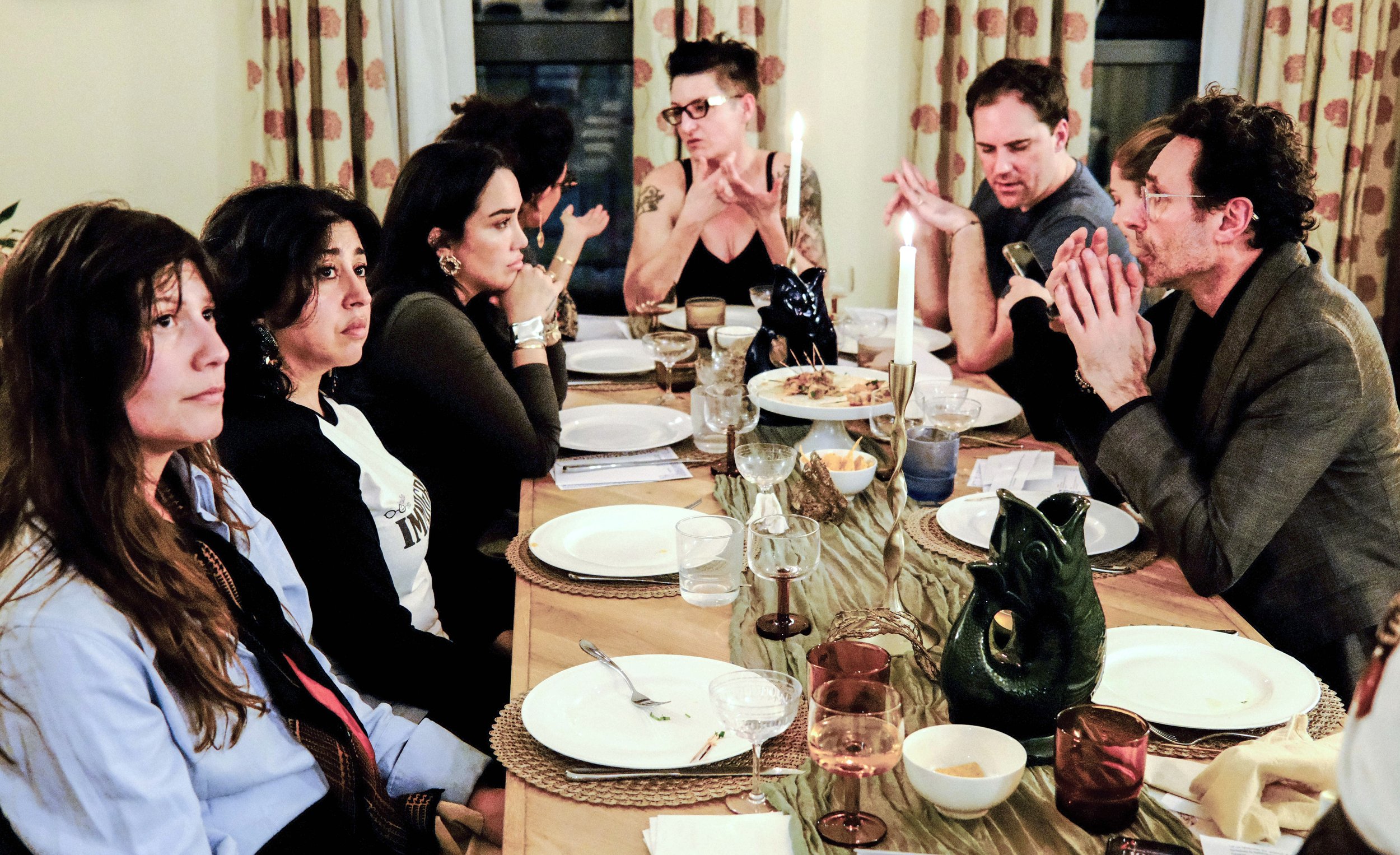
At the beginning of January 2025, I founded a monthly intimate supper club series titled Freudian Bites, in which a small group of guests gathers (8-12 people) in a domestic-style setting in my living room to enjoy a creative four-course meal co-designed with a collaborating chef and artist. For those unfamiliar with it, Freudian Bites is an intimate, research-led supper club series conceived as a living archive, where contemporary art, food anthropology, and psychoanalytic inquiry converge around the table. Hosted in a domestic setting (predominantly in my living room), each edition unfolds as a carefully staged encounter rather than a conventional dinner, treating food as both material and method. The series takes the table seriously as a site of memory, projection, and exchange, where personal histories, cultural inheritance, and political questions surface through taste, conversation, and ritual. Drawing on anthropology, psychoanalysis and curatorial practice, Freudian Bites foregrounds slowness, attentiveness and care, creating a space in which the invisible residues of experience can be sensed and articulated collectively. Each Freudian Bites event is developed through close collaboration with a guest artist and a chef whose practices resonate conceptually and materially. The artist and I shape the evening’s thematic and discursive framework, while the chef responds through a sequence of courses that translate ideas into flavour, texture and gesture. Meals are interwoven with moments of storytelling, readings or performative activations, allowing dialogue to emerge organically among guests. Limited in scale and deliberately intimate, the format prioritises shared attention over spectacle, positioning hospitality as a curatorial tool and the act of eating together as a form of embodied research. Through these collaborations, Freudian Bites becomes not only a supper club but also a platform for testing how art, food, and conversation can generate new forms of knowledge, connection, and care. This project stems from my previous experience working with food as a medium in my curatorial practice for over ten years, as well as from my new anthropological knowledge and theory gained through my MA in Anthropology of Food at SOAS.
The experience combines food, art, and conversation, where the participants are welcomed with a drink, introduced to the artist’s work or ideas, then dine on a bespoke menu while engaging in sensory and conceptual exploration. When the last iteration coincided with Thanksgiving, both the invited artist victoria helena and I wanted to respond to the holiday by interrogating how ritualised national narratives maintain structures of power, belonging, and erasure. The gathering, therefore, approached Thanksgiving not just as a festive meal but as a foundational myth that upholds the United States’ settler-colonial order. Its annual repetition performs what Patrick Wolfe identified as the “logic of elimination”: the continual naturalisation of Indigenous disappearance so the settler can appear as the rightful host, inheritor, and owner of the land (Wolfe:2006). In this context, the Freudian Bites dinner becomes an intervention: a counter-ritual staged precisely at the moment when the dominant ritual of belonging is most loudly celebrated. The original Thanksgiving myth portrays the English settlers’ survival as a story of cooperation and harmony rather than one of displacement, epidemic devastation, land theft, and later militarised domination of Indigenous peoples.
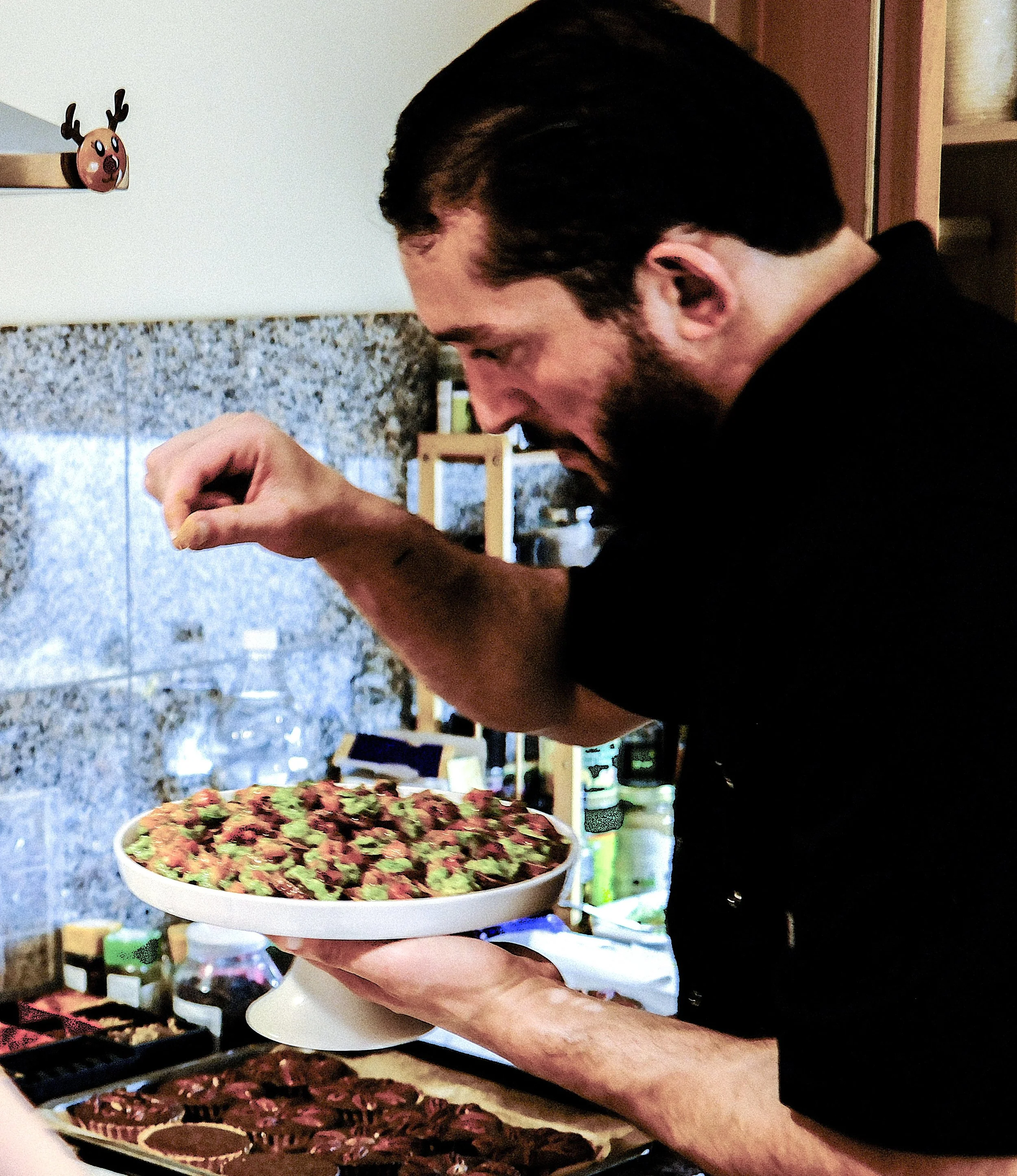
The menu, created by collaborating Algerian-Italian chef Fouad Mansouri in partnership with the private chef company “Yhangry”, played a crucial role in unsettling the conventions of a traditional Thanksgiving feast. Instead of reproducing the expected turkey, cranberry sauce, or pumpkin pie, the Freudian Bites menu unfolded as a diasporic constellation of flavours: salmon teriyaki skewers with pickled ginger, slow-cooked chicken tortilla soup, Middle Eastern lamb marinated in garlic and ginger, vegetable miso stir fry, Mexican-style burritos, and grilled aubergine with honey-tahini dressing, all culminating in a pecan dessert—the only quiet nod to the American canon. Rather than a unified, mythic American plate, the dinner presented a menu shaped by global histories of movement, adaptation and survival, echoing Wolfe’s (2006) insistence that settler colonialism thrives on erasing difference, and Tuck & Yang’s (2012) argument that challenging colonial myths requires discomfort, dissonance, and refusal. Each dish became a reminder that no cuisine emerges from innocence: teriyaki evokes Japanese migration and globalisation; tortilla soup and burritos index Mexican and Latin American diasporas and their racialisation within the United States; miso and tofu reflect histories of East Asian movement and cultural translation; Middle Eastern lamb situates the meal within longer histories of Arab mobility, empire, and culinary dispersal. The table became not a site of assimilation but of plural, intersecting migrations, mirroring the layered identities found in victoria helena’s artistic statement: Polish, Croatian, American, undocumented, queer, neurodivergent, shaped by generational trauma and displacement. Chef Fouad’s own heritage deepened these dynamics: as someone formed between Mediterranean Europe and North Africa, his culinary imagination resists the purity narratives that underpin both nationalism and settler colonial foodways.
In shaping a menu that crossed continents, traditions, and emotional registers, he enacted what Homi Bhabha describes as the third space: a hybrid zone where identity and culture are not fixed but continuously negotiated, translated, and remade (Easthope, 1998:145-151). Thus, the menu itself functioned as an embodied critique of Thanksgiving. It fractured the colonial fantasy of a singular American origin story by staging a table of many beginnings, many crossings, many inheritances. It reminded guests that migration is not an exceptional rupture but the fundamental condition of contemporary life, and that the foods we call “traditional” are themselves products of movement, encounter, and exchange. In this way, the supper club performed a form of culinary decolonisation: it refused to honour the myth and instead honoured the histories the myth seeks to suppress.
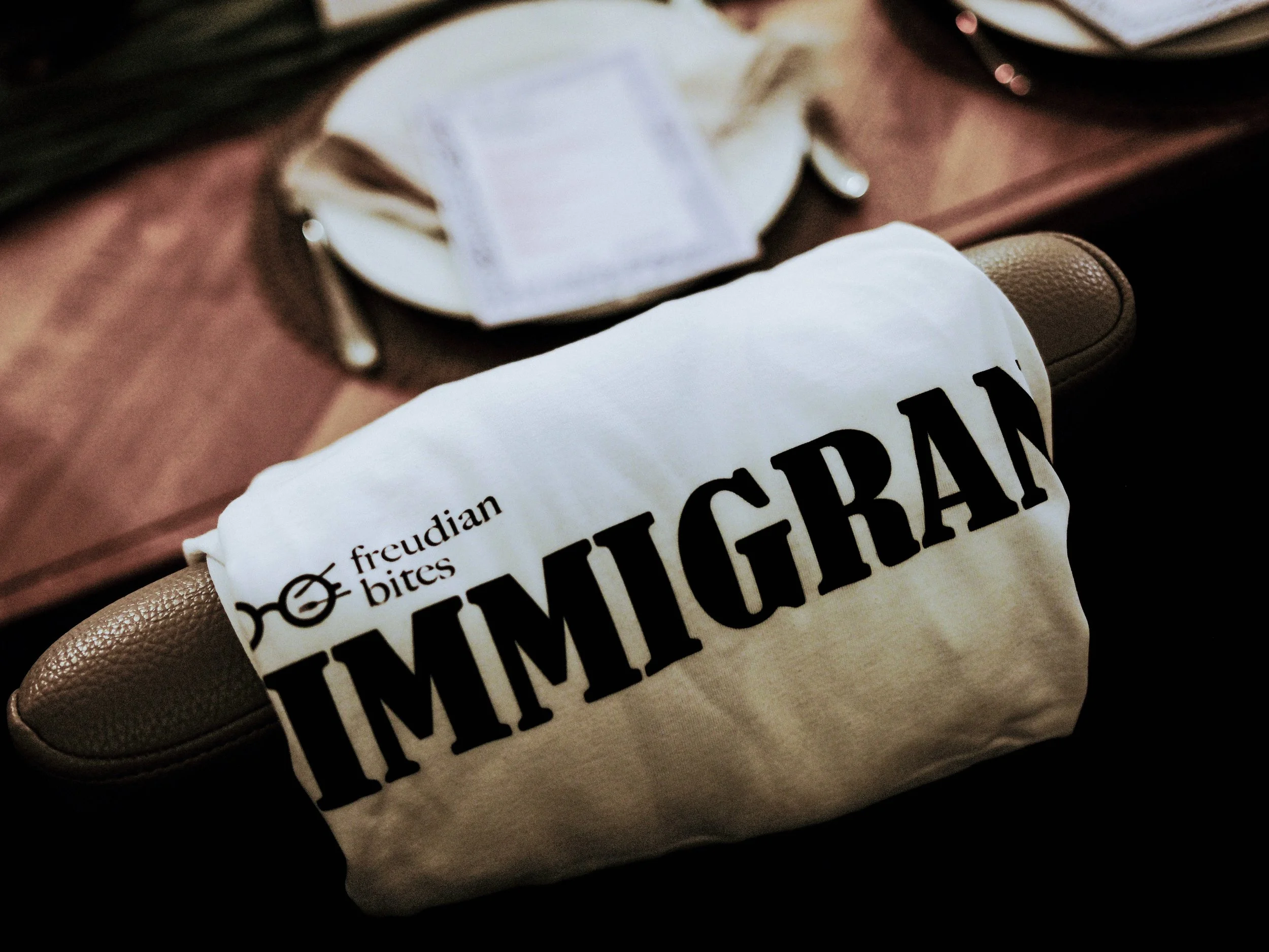
As part of the supper club, victoria helena designed shirts with the word “IMMIGRANT” printed on them, with proceeds from sales going to All Our Relations. Therefore, the shirts directly explored the traditional hierarchy between settlers, immigrants, and Indigenous peoples. In U.S. settler colonial discourse, “immigrants” are positioned as perpetual outsiders while settlers are framed as natives-by-right.
Freudian Bites, November 27th, 2025 Photo by Seçkin Uysal
Freudian Bites, November 27th, 2025 Photo by Seçkin Uysal
Freudian Bites, November 27th, 2025 Photo by Seçkin Uysal
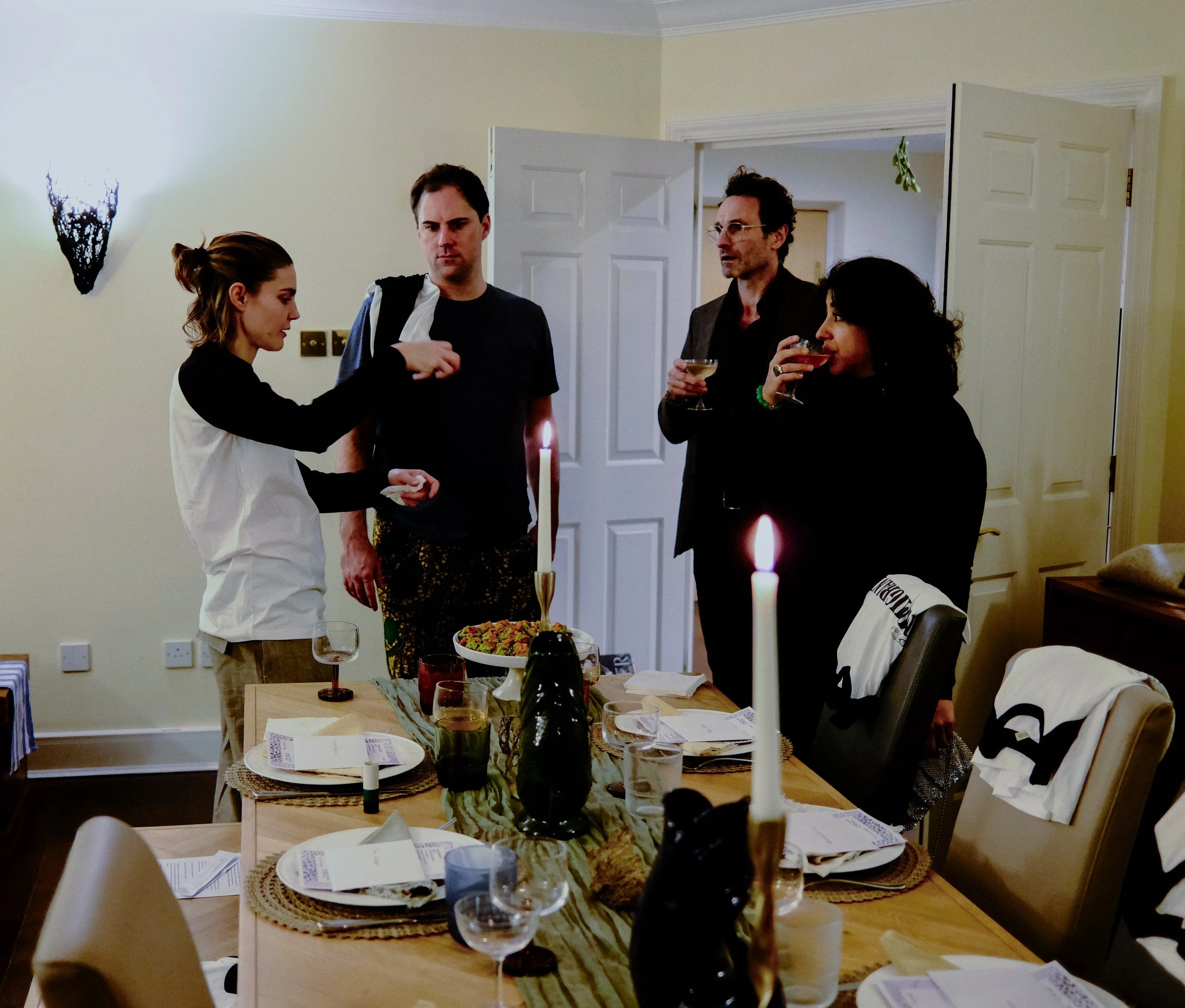
Freudian Bites, November 27th, 2025 Photo by Seçkin Uysal
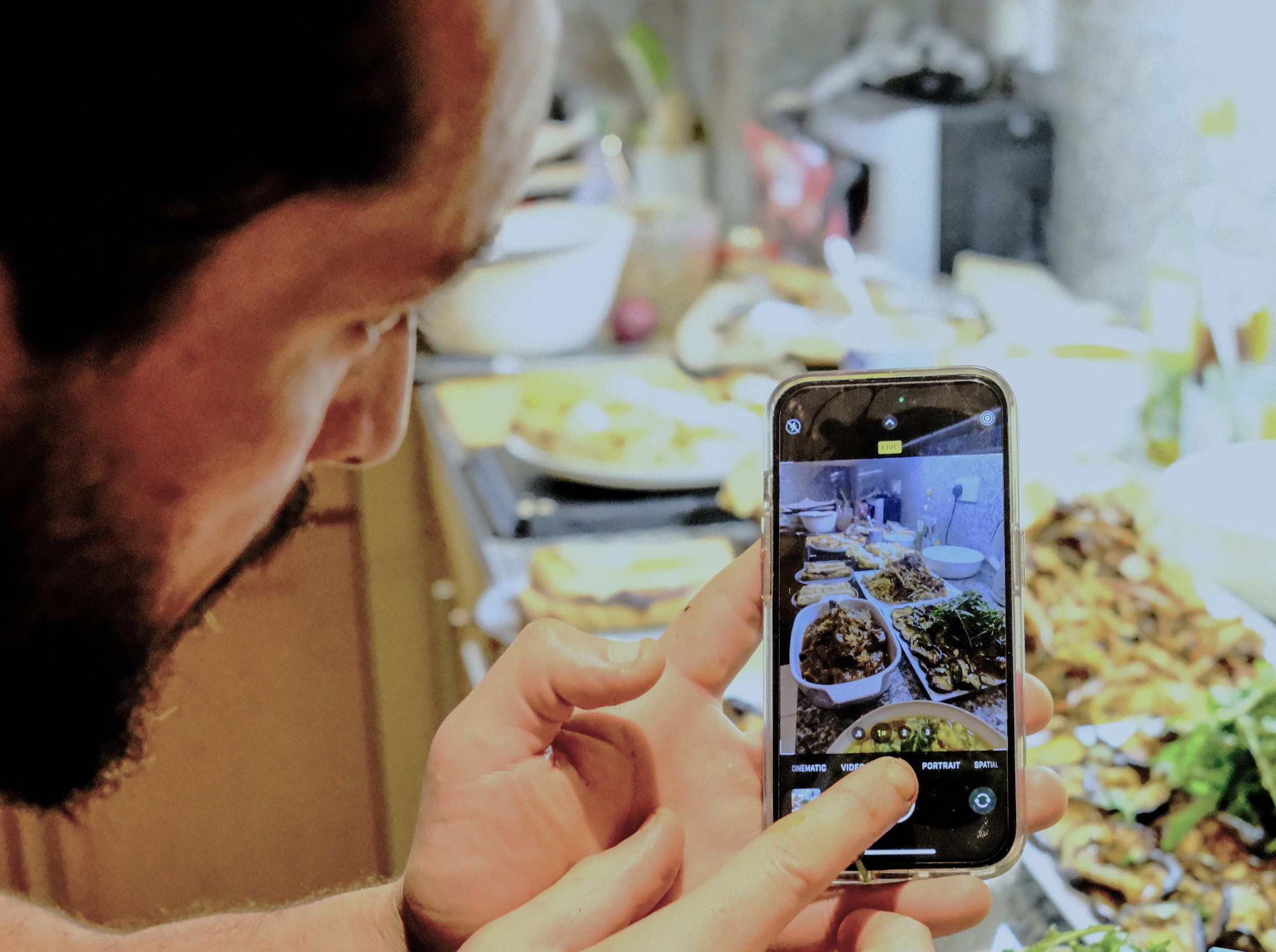
Freudian Bites, November 27th, 2025 Photo by Seçkin Uysal
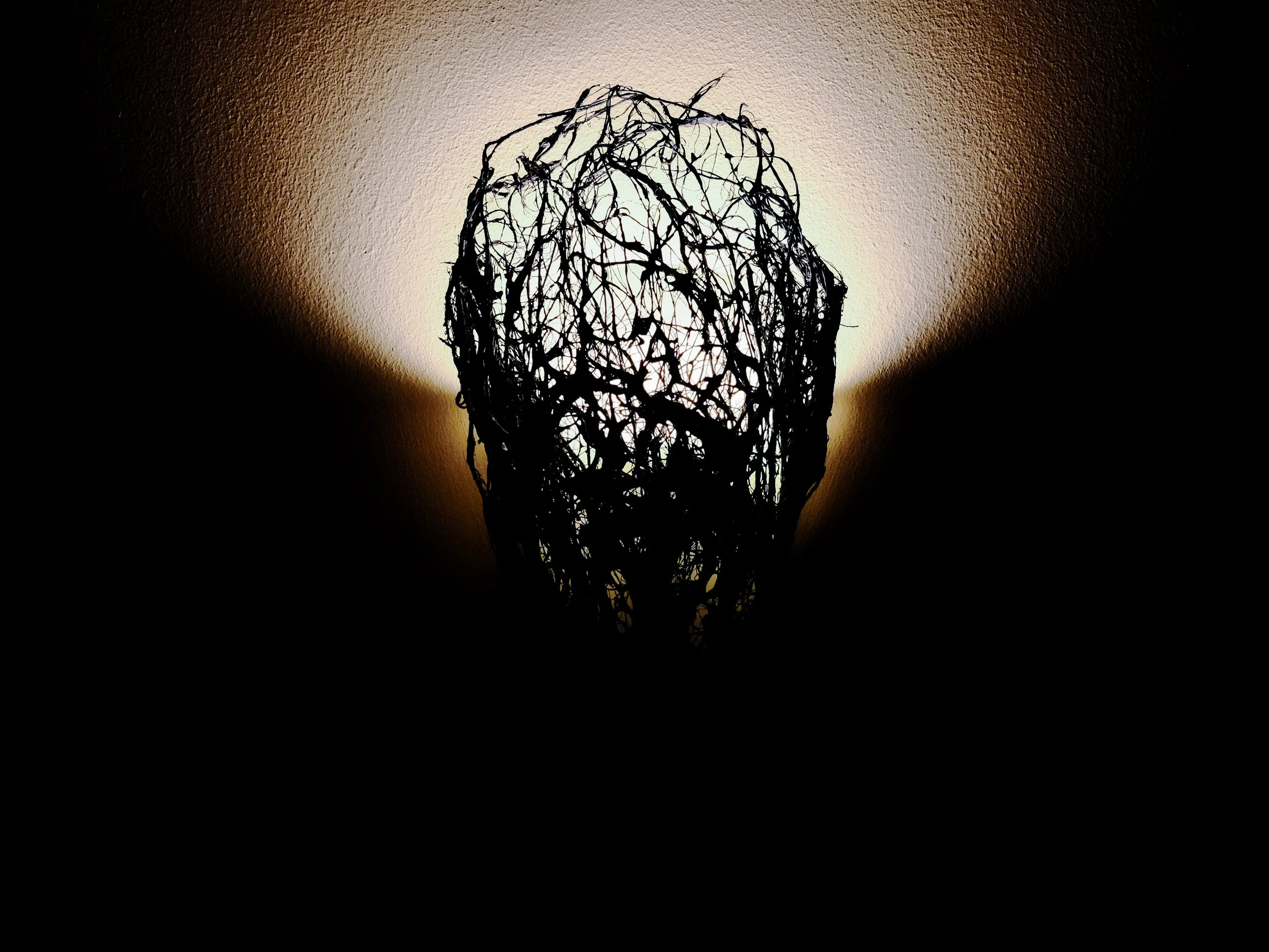
Artworks by victoria helena at Freudian Bites, November 27th, 2025 Photo by Seçkin Uysal
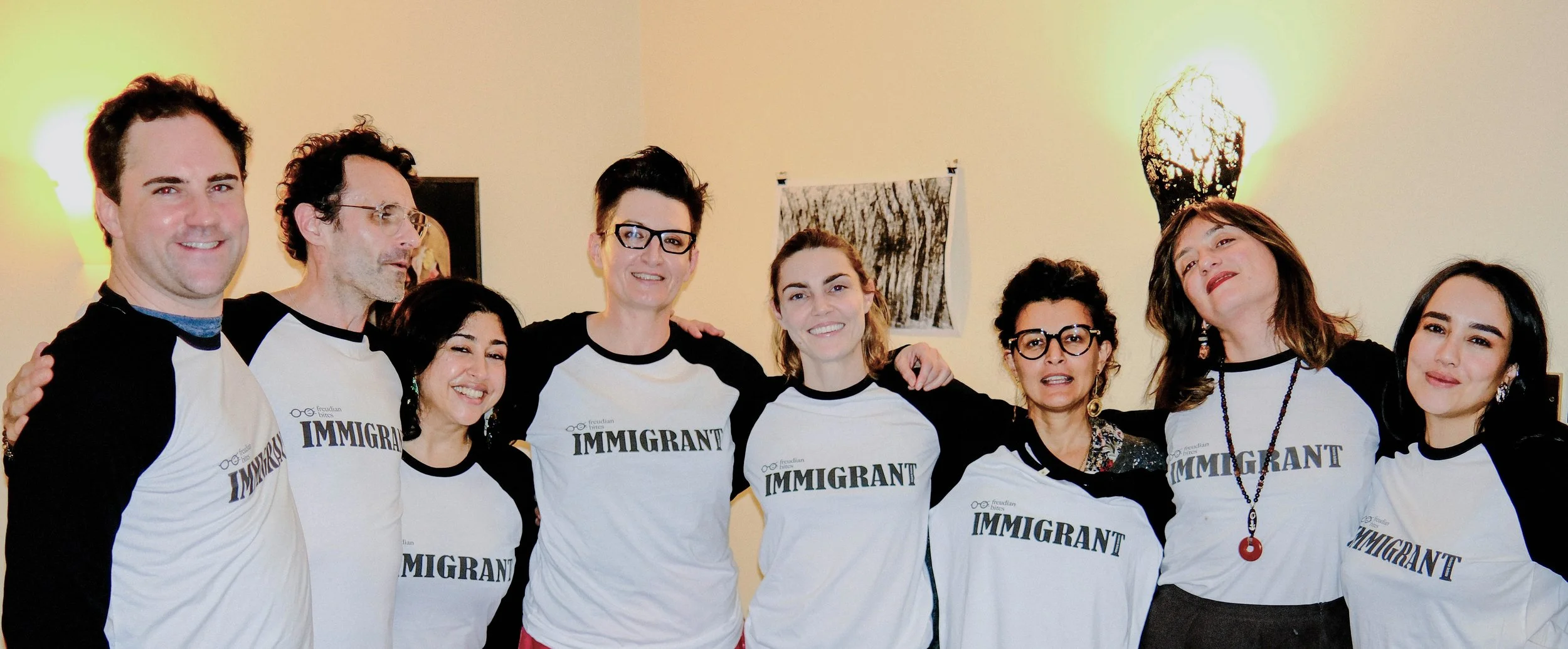
Freudian Bites, November 27th, 2025 Photo by Seçkin Uysal
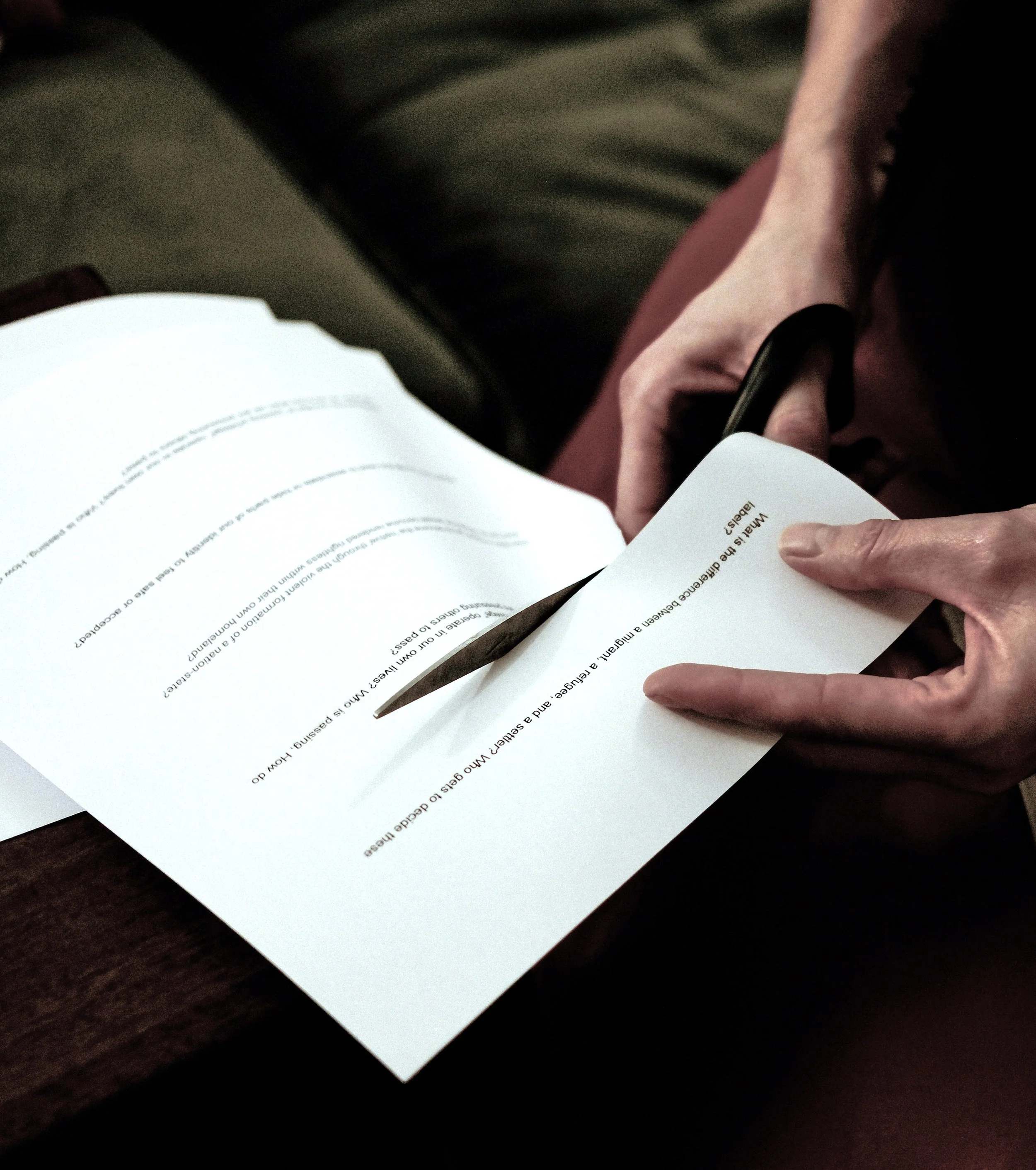
In settler-colonial contexts, immigrants are often positioned as perpetual outsiders, while settlers are framed as naturalised and entitled. As Mark Rifkin (2014) argues, this collapse of categories is part of what secures settler sovereignty: it displaces Indigenous claims by positioning immigrants and settlers as equivalent newcomers navigating the same terrain. By placing the word “IMMIGRANT” on every participant’s gifted shirt, the dinner unsettled these distinctions. The shirt implicitly asked: Who is truly foreign? Who is rendered native in national narratives? Who is erased altogether? And the greater question: Is there a difference between immigrant and migrant? According to the official website of the International Rescue Committee, a refugee is defined as an individual who has been forcibly displaced due to war, violence, or persecution and cannot safely return home until conditions fundamentally change. By contrast, a migrant is an umbrella term without a fixed legal definition in international law; it describes a person who leaves their home, whether across borders or internally, for a range of reasons, which may be temporary or permanent. An immigrant, meanwhile, is someone who voluntarily relocates to another country with the intention of long-term or permanent settlement, typically undergoing formal vetting and legal entry procedures. I outline these distinctions here to clarify the terminology used throughout this essay and the intentionality behind our language choices. Both victoria helena and I identify as immigrants; however, no one at the supper table or in the kitchen during Freudian Bites occupied the legal categories of migrant or refugee. The conceptual distinctions matter precisely because the essay engages with the symbolic and political weight of these terms. Terms that extend far beyond their bureaucratic definitions and shape the lived experiences of displacement, belonging, and identity.
The shirts made visible what De Genova (2018) describes as the racialised politics of migration, wherein certain bodies are always already marked as nonbelonging, regardless of citizenship status. In We Refugees, Arendt describes how refugees remain marked by their displacement even after gaining citizenship. She writes that refugees “do not like to be called ‘refugees’” (1996:110) because the term attaches them to past persecution and a loss of worldliness that cannot be undone. Freudian Bites reframed this mythology by shifting the focus from gratitude as entitlement to gratitude as relational accountability. Where the Thanksgiving table historically marks the settler’s claim to land, identity, and indigeneity-in-waiting, the Freudian Bites table reconfigures the act of eating together as a political encounter, highlighting the asymmetries and violences that structure belongs to. Through a banquet of food, discourse, and collaborative creativity, the evening asked participants not to rehearse the affective comforts of colonial nostalgia but to metabolise discomfort: to sit with contested memory, structural privilege, and the ongoingness of colonial dispossession. Responding directly to Arendt’s earlier essay of the same title, Giorgio Agamben explicitly opens his text by stating that Arendt “overturns the condition of the refugee” in order to make it “the paradigm of a new historical consciousness” (1995:114). He takes seriously Arendt’s claim that refugees expose the fragility of the political categories that bind modern life together. Agamben develops Arendt’s insight by arguing that the refugee is not simply a symptom of political breakdown, but the central figure of contemporary political life. He writes that, due to the collapse of the nation-state’s ability to absorb displaced populations, “the refugee is perhaps the only imaginable figure of the people in our day” (1995: p.114).
The Freudian Bites Thanksgiving edition materialises, in embodied form, the arguments made by Agamben, Arendt, Mbembe and De Genova: that the categories “migrant” and “refugees” are never simply legal designations but enduring social positions -ones that persist, mutate, and attach themselves to bodies long after formal status changes. Arendt ([1943]1996) famously noted that refugees do not stop being refugees upon naturalisation, because what haunts them is not their paperwork but the rupture of worldliness that exile produces. A rupture kept alive through the gaze and suspicion of others. Likewise, Mbembe’s concept of borderization demonstrates that migrant status is continually reproduced through technologies of surveillance and racialised mobility control; the border, he writes, migrates with the undesired body, transforming the individual into a site of ongoing securitisation. De Genova adds that “migrant” operates as a racialised subject-position in Europe and the US, where even the second or third generation citizens by birth remain marked as migrant through a politics of perpetual foreignness. The conceptual dinner enacts these theories by making visible how displacement becomes an intimate, bodily condition rather than an administrative one. The event’s focus on Thanksgiving as a foundational settler-colonial ritual foregrounds how certain subjects are never considered migrants, because settler identity presupposes innocence, nativeness, and rightful belonging.