

Alice Nien-pu Ko
Faraway, Nearby: Archipelagic Proximities in Between Waves
A radio dial turns slowly. Between stations: static, overlapping frequencies, a sudden swell of voices, a percussive shimmer that seems to come from everywhere at once. In José Maceda’s Ugnayan (1974), a composition broadcast simultaneously across multiple radio frequencies, sound becomes an architecture of relation—a city briefly stitched together by waves, interference, and shared attention. The work proposes that music need not be anchored in a concert hall or a single listening point; it can spread across domestic interiors, streets, and radios, forming a temporary, invisible commons. The ocean is not pictured here, yet its logic is present: transmission, drift, return; a medium that connects without erasing distance, holding together dispersed listeners in a shared but uneven field of sound.
Maceda’s devotion to islands was never only intellectual; it was a lifelong practice of listening. Moving across the Philippine archipelago, he treated each island not as a point on a map but as a living acoustic world—breath, pulse, drumskin, bamboo, water, wind, and the collective timing of bodies. What he gathered through fieldwork was more than documentation; it was an ethics of attention, an acknowledgment that sound carries social memory, that communities calibrate relation, labor, ritual, and survival through rhythm and resonance. In works such as Ugnayan, this care for island life is transformed into a composition: music shifts away from the stage toward archipelagic forms of dispersal, simultaneity, and return. Broadcast waves braid distance into temporary proximity, allowing listening itself to become shared terrain. In this sense, Maceda does not simply write music about islands; he composes with the conditions of archipelagic existence—separation without isolation, connection without uniformity, in a field continually reshaped by currents, weather, and the movements of many.
From a related but distinct vantage, Epeli Hau’ofa’s seminal essay Our Sea of Islands (1993) challenges colonial cartographic narratives that depict islands as isolated, dependent peripheries. Instead, he reimagines the Pacific as a vast, interconnected network of histories, kinship structures, and cultural exchanges. Hau’ofa dismantles the perception of the ocean as a void separating landmasses, asserting instead that it is a space of movement, continuity, and transmission—a bridge rather than a barrier. Syaman Rapongan, a writer and fisherman from Orchid Island (Lanyu), Taiwan, expands this framework by grounding it in indigenous Tao (Yami) epistemologies. For Rapongan, the ocean is not an obstacle to be crossed but a living entity—an ancestral archive and a space of coexistence between humans and non-humans. Lanyu’s history, shaped by Japanese colonization, Cold War geopolitics, and the ongoing nuclear waste crisis, informs his alternative vision of island life beyond extractive and colonial paradigms. Against modernist views that cast the ocean as vast and inhospitable, Rapongan asserts it as a kinship space, where survival depends on a reciprocal relationship with its rhythms and movements. To inhabit an island, he suggests, is to be attuned to the ocean’s shifting conditions, its moods, and its generational memory.
Between Waves builds from these propositions by treating proximity not as mere spatial nearness, but as a curatorial method that foregrounds islands as zones of mediation rather than isolation. It is staged as an arrangement of works in which image, sound, ritual, and historical time seep across boundaries like tides, generating encounters that are affectively registered before they are fully named. By casting the ocean as an active agent rather than a passive backdrop, the exhibition approaches the sea as a living archive and contested medium— one that simultaneously binds and wounds, sustains and exhausts— within which artists recompose its histories into forms of resistance, mourning, and futurity.
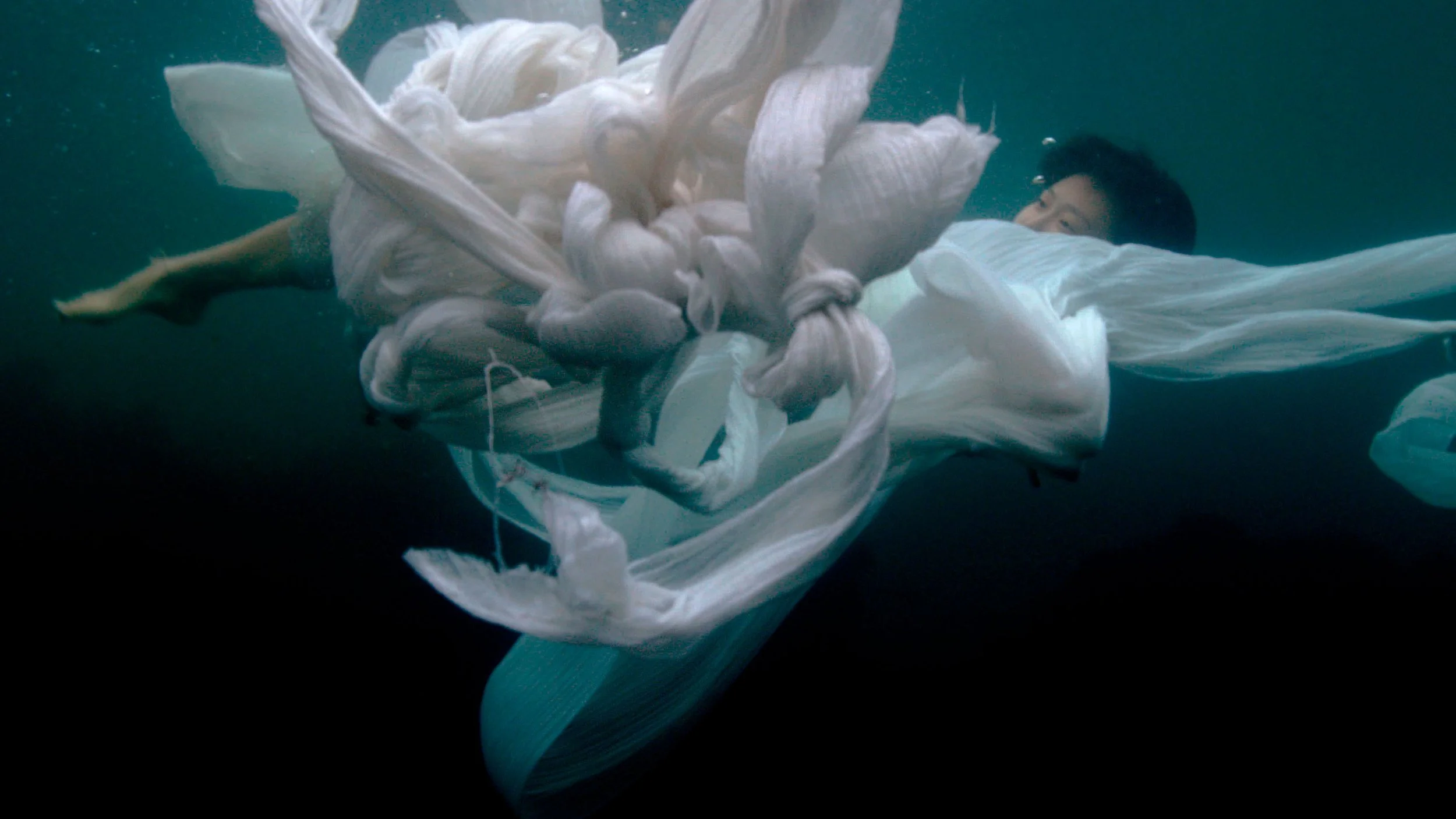
These undercurrents of relation and memory become tangible in specific coastal sites and practices. One such articulation appears in the work of Jane Jin Kaisen, whose practice engages shamanic traditions on Jeju Island, where coastal landscapes, ritual knowledge, and suppressed histories remain densely entangled. Her moving-image work Offering—Coil Embrace (2020) transforms the ocean into ritual ground—a site of remembrance, resilience, and mourning enacted through a choreographed underwater performance. Developed in collaboration with Jeju haenyeo (women divers) involved in environmental preservation, the film braids together shamanic cosmology, bodily endurance, and historical trauma. At its center is sochang, a long white cotton cloth traditionally used in rites of passage and associated with acts of weaving and caregiving. As the fabric unfurls underwater, it appears as a spectral presence—an embodiment of matrilineal knowledge and a visual metaphor for the cycle of life and death. Gradually tinged with red, the cloth figures the ocean as both vessel of continuity and repository of loss, quietly invoking the untold number of Jeju civilians who perished at sea during the 1948 Jeju Massacre.
Filmed in slow motion, Offering—Coil Embrace captures the haenyeo’s submerged choreography with a dreamlike fluidity, reinforcing the rhythmic intimacy between the divers and the tides. The interplay of fabric, bodies, and water resists linear narratives of history, instead presenting memory as something suspended, mutable, and constantly shifting. The ocean, rather than a passive expanse, becomes a space where past violence, ecological fragility, and matrilineal resilience are entwined. Through this immersive visual language, Kaisen invites viewers to navigate a space where ritual, grief, and survival converge in the depths, modeling the kind of oceanic, relational proximity that Between Waves takes as both method and horizon.
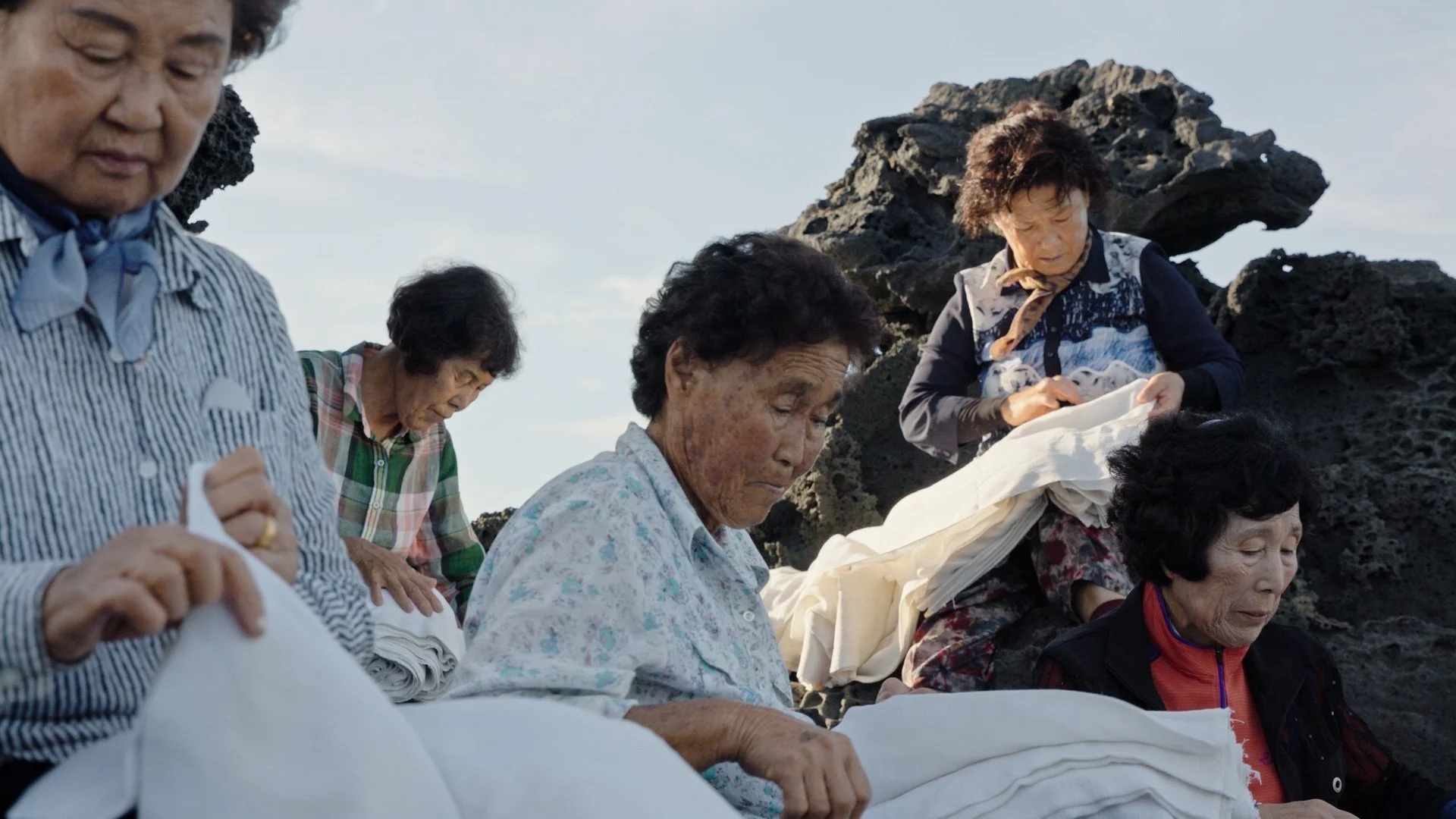
Jane Jin Kaisen, Offering—Coil Embrace (2023). Still from film, 12 mins. Courtesy of the artist
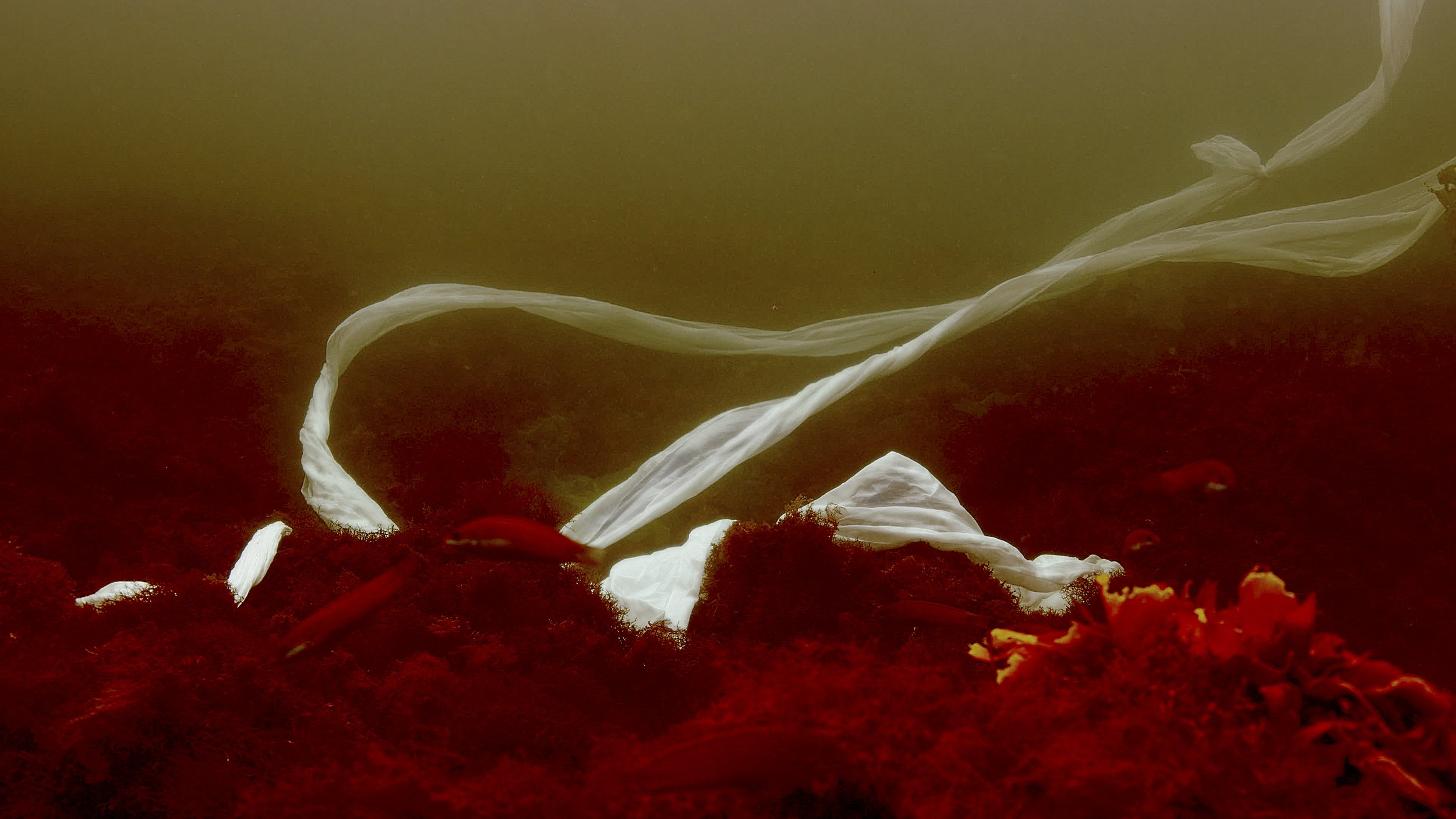
Jane Jin Kaisen, Offering—Coil Embrace (2023). Still from film, 12 mins. Courtesy of the artist
Currents
If the Black Atlantic has been a crucial field for thinking the ocean as a space of forced movement and resistant relation, Between Waves moves along a different but entangled set of routes: the currents that bind East and Southeast Asia, the Pacific Rim, and island worlds. Building from the tidal temporality
that Kaisen embodied underwater, the exhibition turns to the sea itself as a figure for death, rebirth, and unfinished time. Waves do not simply mark the passing of moments; they stage a continual oscillation in which disappearance and return are inseparable, so that what is submerged is never entirely lost. Rather than a single linear timeline, the works in the exhibition trace two interlaced temporalities: one that seeks to locate events in chronological sequence, and another in which time folds back through memory, sending the past repeatedly into the present in altered form. Seen from here, the Kuroshio Current becomes more than an oceanographic phenomenon. It is a warm, moon-governed archive that carries plankton and fish, shipwrecks and cables, radioactive particles and stories of flight along the same restless stream. Flowing northward from the Philippines past Taiwan and Okinawa toward Japan, the current enacts a cyclical temporality in which life and death, erosion and regeneration, catastrophe and recovery are held together in a single, ceaseless motion. In this sense, the Kuroshio and surrounding oceanic zones function less as “natural backdrop” than as a theory-field: a way of reading how colonial histories, Cold War, and contemporary logistics have folded island communities into global circuits of extraction and security. The past does not remain fixed “behind” the present; it drifts, recirculates, and washes ashore on different coasts, transformed yet still legible. To follow these currents is thus to think time not as linear progress toward resolution, but as a series of returns and reconfigurations—a wave-form in which endings fold back into beginnings, and in which island worlds must continually renegotiate how to live with what the sea delivers back to them.
If the Kuroshio names a song, Japanese pioneer photographer Shomei Tomatsu’s Untitled (Hateruma Island, Okinawa) (1971) may be read as one of its early, oblique footnotes. Turning his lens from the main island to the outer Ryukyus, Tomatsu shifts away from the spectacular proximity of bars and military bases toward the quieter thresholds of village roads, shorelines, and sky. In the Hateruma photograph, the island does not appear as a picturesque periphery, but as a frontal encounter with a world calibrated by wind, salt, and the slow erosion of structures under tropical light. Even when the sea is absent or pushed to the edge of the frame, Tomatsu’s Okinawa pictures are saturated with its humidity and weather, registering occupation as something carried on salt air as much as in fences and ruins. Tomatsu thus inscribes the Ryukyus into a wider archipelagic field, anticipating the conditions that later artists such as Mao Ishikawa and Futoshi Miyagi will confront more directly: islands as nodes in a circulating current of empire, labor, and memory, rather than isolated points at the edge of the Japanese nation-state.
Where Tomatsu often renders the violence of occupation through symbolic fragments—fences, wreckage, bombscarred bodies—Ishikawa insists on the lived, complicated textures of everyday life around the bases, especially from the standpoint of working-class women. Her women are not allego ries of national victimhood; they are specific individuals, with style, humor, bad nights and good ones, and their own ways of navigating desire and damage. In this sense, Red Flower can be read as a feminist and decolonial counter-archive to both state narratives and mainland Japanese representations of Okinawa.
If Ishikawa maps the hard edges of the island, Futoshi Miyagi’s The Ocean View Resort (2013) moves along more intimate currents, where desire and memory intersect with the lingering afterimages of war. Part of his American Boyfriend series, the video returns to an Okinawan shoreline marked by overlapping sovereignties: a remote hometown beach where a derelict resort stands as a quiet monument to shifting regimes of tourism, militarization, and aspiration. Walking along the shore with Y—a childhood friend and unspoken love—the narrator, voiced by Miyagi, listens as wartime memories surface: massacres of civilians by Japanese soldiers, guerrilla resistance, the violence folded into caves and cliffs. The voice then drifts to another narrative: a Japanese prisoner of war recalling a fleeting moment of tenderness with an American soldier as Beethoven plays through the fence of a camp. These layered recollections, intercut with the narrator’s memory of riding home at night on the back of Y’s bicycle, conjure a shoreline where private attachments and geopolitical histories are inseparable.
In The Ocean View Resort, history does not unfold as a clean sequence of before and after; it moves like surf, arriving in fragments, receding, and returning altered. Male intimacy, militarized occupation, American cultural influence, and local longing are all carried by the same coastal current. Okinawa appears not only as a site of strategic importance but as a terrain of spectral memory and shifting identity, where the sea keeps bringing back what official narratives attempt to smooth over.
Faraway, nearby
The curatorial approach of Between Waves centers on anaesthetics of proximity, less a question of distance than a wayof inhabiting shared practices of storytelling, movement, and inhabiting. Proximity is not reducible to intimacy or simple nearness; it describes a condition of being held within the same currents, exposed to the same weather of history, without collapsing difference. Across the exhibition, artists reveal how proximity in archipelagic contexts is an ongoing negotiationshaped by tides, ecological interdependencies, and historicalmemory. It is the diffuse yet palpable sense of being suspendedin the same archipelagic pressure systems, even when bodies and islands remain far apart. It links the held breath and submerged choreography in Jane Jin Kaisen’s underwater scenesoff Jeju, and the Okinawan shorelines where war, tourism, andqueer remembrance move along the same strip of sand. Acrossthese instances, relation is neither abstract nor purely metaphorical—it is atmospheric, tidal, and uneven. Proximity, in this sense, is the latent logic that has been carried all along: a way of thinking with waves, currents, and archipelagos as forms through which stories, wounds, and solidarities travel, sometimes audibly, sometimes as a low, persistent undertow.“Relation is not made of one, but of many,” writes Édouard Glissant in his Poetics of Relation, proposing a world in which connections do not culminate in fusion but in a dense,shifting weave of entanglements. Rather than seeking transparency or assimilation, Glissant insists on the “right to opacity,” amode of being-with that allows differences to remain partiallyunknowable even as they touch. In his archipelagic thinking,t he sea is not an empty expanse separating stable blocks of land, but a moving milieu of routes, encounters, and unforeseen crossings, a space where histories and bodies pass close to one another without resolving into a single, legible whole. Kamau Brathwaite, writing from the Caribbean as well, turns to the tide to describe a similar logic of relation: his notion of tidal ectics counters the fixed, linear progression of Western dialectics with the uneven, recursive movement of waves that advance, withdraw, and return in altered form. History, for Brathwaite, does not unfold in straight lines but in surges and backwash—the hurricane that “does not roar in pentameters,” but in off-beat, syncopated rhythms. Taken together, Glissant and Brathwaite offer a conceptual horizon for the aesthetics of proximity that undergirds Between Waves: a way of understanding relation as rhythmic rather than static, non-totalizing rather than incorporative, a condition of sharing the same sea and weather without ever collapsing into sameness.
In Between Waves, an aesthetics of proximity is made legible at the level of practice. In Offering—Coil Embrace and Halmang, Jane Jin Kaisen pursues this logic through collaborative, embodied engagement with the haenyeo; proximity is registered in shared breath before submersion, in the patient attention to gestures that transmit knowledge laterally between women, sea, and deities rather than vertically from observer to observed. Futoshi Miyagi’s The Ocean View Resort traces another register of proximity, in which queer longing, wartime memory, and tourist ruin inhabit the same shoreline, layered in voice-over so that private attachments and geopolitical histories move along a single coastal current. Across these practices, proximity is neither anecdotal intimacy nor distant contemplation, but a sustained labour of staying with specific sites, languages, and bodies over time—allowing relation to emerge as tidal, negotiated, and at times uncomfortable. It is this kind of proximate, situated engagement that Between Waves seeks to foreground as both its method and its claim.
Within the exhibition, this ethos of proximity unfolds not only within individual works but in the intervals between them: in the bleed of sound from one gallery into another, in the visual rhymes between coastal horizons, in the way a viewer’s path is repeatedly drawn back to the sea as both image and acoustic presence. Proximity here is also a curatorial risk, inviting frictions and overlaps rather than cordoning each work into self-contained space. To move through Between Waves is thus to inhabit an environment where relations are felt before they are fully articulated—a field in which oceanic histories, island cosmologies, and contemporary struggles for sovereignty press against one another at close range, asking the visitor not only to look, but to remain with the tensions that proximity makes visible.
The past is ahead, in front of us
The wave never moves alone. It carries histories and futures, drifting across distances, refusing containment. If colonial maps sought to fix islands in place, the works in Between Waves reposition them as living currents of memory, resistance, and adaptation. The ocean is not a void but a vessel—one that continues to shape the past, the present, and what is yet to come. To curate in an archipelagic mode is to move between waves, to resist fixed borders, and to reclaim the sea as a site of entanglement rather than separation. Between Waves is not only an exhibition, but a call to listen, to drift, and to imagine beyond imposed limits. Epeli Hau’ofa reorients our perception of time and history when he writes that “the past is ahead, in front of us,” always in view, while the future, behind us, “cannot be seen and is liable to be forgotten readily.” This reversal disrupts linear historiographies, foregrounding indigenous epistemologies in which past and future are not opposed but entangled temporalities. Between Waves embraces this understanding, positioning indigenous knowledge systems, ecological entanglements, and mythic storytelling as methodologies of survival and resistance. The sea is not a corridor to be crossed; it is a dynamic medium of transmission, a connective tissue of kinship, a force that unsettles the illusion of permanence. If colonial cartographies sought to fragment the ocean into militarized frontiers and economic corridors, Between Waves asks what becomes possible when we reframe the ocean as an expansive site of relation rather than division.